Choose signals before you choose software. A bigger contact database doesn’t create pipeline on its own, and in a market that has clearly matured into a mainstream revenue technology category, the better question is which signal your team can act on. The sales intelligence market has already grown from about USD 2.95 billion in 2022 to USD 3.65 billion in 2025, with long-term forecasts stretching into the USD 6.68 billion to USD 9.02 billion range depending on methodology, which tells you the category is no longer about novelty, it’s about operational fit market overview.
That shift matters because the best sales intelligence tools don’t just surface names, they connect a specific buying signal to a real workflow. A LinkedIn comment, a job change, an account-level research spike, a website visit, or a fresh enrichment event all mean different things, and they need different owners, response windows, and destinations in CRM or outreach systems. The right comparison isn’t “which platform has the biggest database,” it’s “which platform gives us the cleanest signal, the fastest qualification path, and the least operational drag.”
This list is organized by the kind of signal each platform supports, then by how well it fits the rest of the motion, from detection to qualification to outreach and sync. You’ll see where person-level triggers beat account-level intent, where enrichment matters more than orchestration, and where implementation complexity can erase the value of a strong data layer. The goal is to help you combine tools intelligently, not treat every vendor like a swap-in contact database.
Table of Contents
- 1. LeadBeast
- 2. ZoomInfo SalesOS
- 3. Apollo.io
- 4. LinkedIn Sales Navigator
- 5. 6sense Revenue AI
- 6. Demandbase One
- 7. Cognism
- 8. Clearbit
- 9. Bombora
- 10. UserGems
- Top 10 Sales Intelligence Tools Comparison
- Build a Signal-to-Conversation Stack
1. LeadBeast
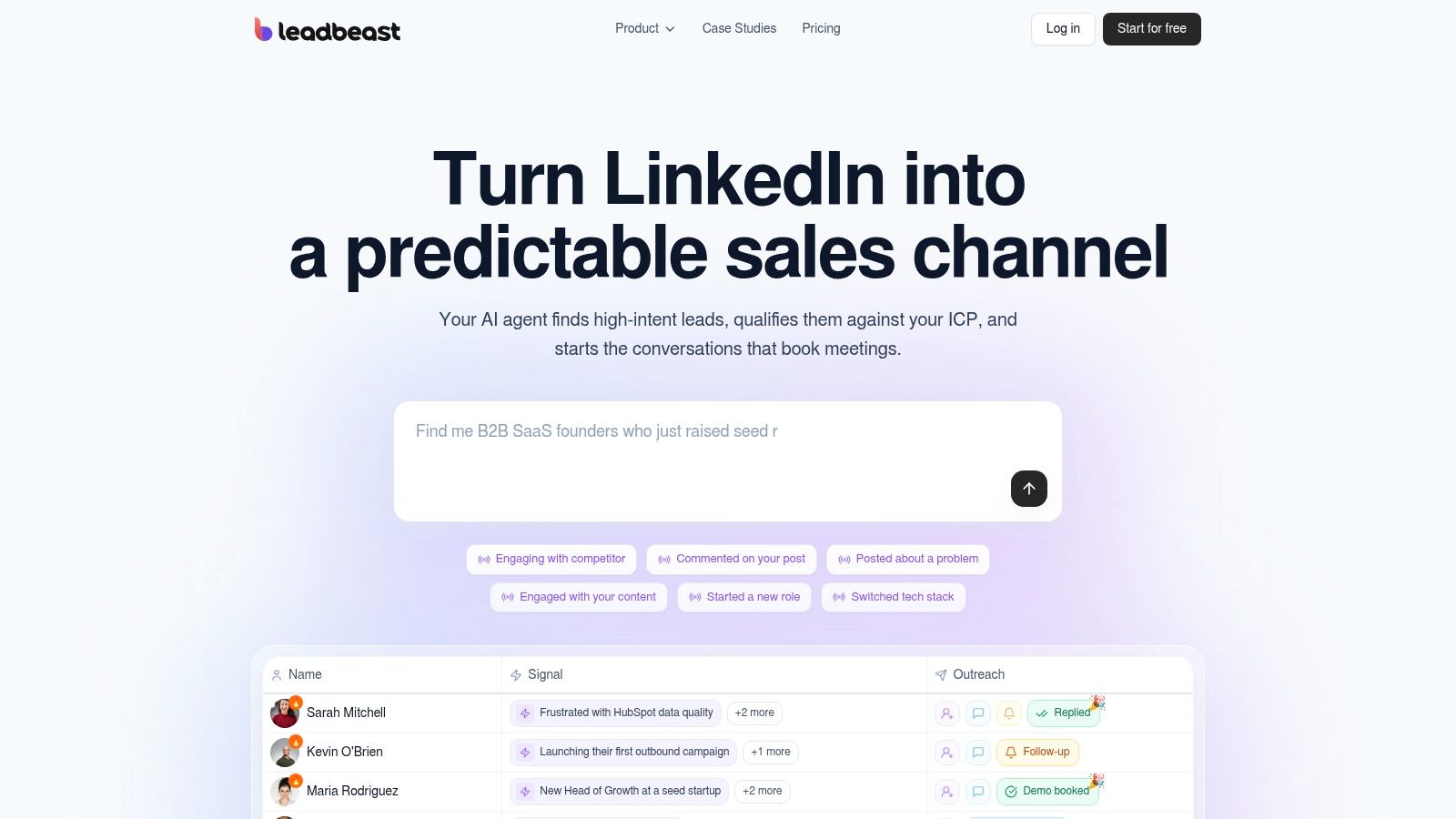
LeadBeast focuses on person-level triggers, making it a strong fit for LinkedIn-native outbound. It monitors live LinkedIn activity, role changes, and competitor engagement, then compares those signals with a plain-language ICP. Reps can prioritize profiles showing current relevance instead of treating every contact as equally ready for outreach LeadBeast.
Why it fits trigger-based outreach
The product’s main advantage is the route from detection to execution. It creates audiences that refresh automatically, enriches and scores leads, and syncs them in both directions with CRM and outreach tools. That removes manual CSV exports and reduces the risk of outdated prospect lists.
The workflow centers on moment-matched outreach. A rep can respond to a relevant LinkedIn action while the context is still fresh, rather than placing an unqualified name into a standard sequence.
Practical rule: Choose LeadBeast when public LinkedIn behavior is a meaningful buying signal. It is the wrong fit for anonymous web-traffic prospecting or broad account research.
Implementation still depends on the quality of the ICP and messaging. The platform cannot compensate for unclear targeting, weak copy, or a requirement for a standalone mobile workflow. Teams that already know which people matter can gain more value from its real-time detection, safety-first delivery, and CRM handoff than from another general contact database.
2. ZoomInfo SalesOS
ZoomInfo SalesOS is built for teams that need broad contact coverage and account intelligence, not a narrowly focused trigger workflow. Its strongest signal is account-level context: company attributes, organizational changes, technologies, and news that help sales teams decide where to focus before identifying the right people.
Strong when the process is already mature
The platform combines contact and company intelligence, org charts, direct dials, technographics, and “Scoops” news alerts. That mix supports territory planning, account research, and multi-threading without requiring reps to assemble information from several databases. It works best when sales operations has defined CRM rules and can turn enriched records into consistent routing, segmentation, and outreach workflows.
ZoomInfo’s breadth also creates operational trade-offs. Data coverage and enrichment are useful only when teams maintain field standards, ownership rules, and regular verification. The platform may provide account-level triggers, but reps still need a separate process for deciding whether a person-level event justifies immediate contact.
Opaque pricing, seat minimums, and credit add-ons can make costs difficult to forecast when adoption varies across the team. For organizations with established operations that can absorb configuration and administration, SalesOS offers a substantial data layer. Smaller teams may capture more value from a narrower tool with faster setup and simpler workflow fit. ZoomInfo SalesOS
3. Apollo.io
Apollo.io is the most practical all-in-one option for teams that want database plus engagement without assembling a stack from scratch. It combines enrichment, prospecting, sequences, an AI assistant, and website visitor identification, which makes it attractive for smaller teams that need speed more than enterprise architecture Apollo.io. For teams still deciding whether to split prospecting and outreach into separate systems, that bundling removes a lot of friction.
Read the workflow angle in this guide on sales automation software if you’re trying to decide how much should live inside one platform versus a broader stack.
Best when speed beats specialization
Apollo’s appeal is that it shortens the path from research to action. You can enrich from CSV, API, or CRM, then move into sequencing inside the same environment, which reduces context switching and gives lean teams a workable operating system. That matters because the category is no longer won by whoever stores the most contacts, it’s won by whoever gets usable signals into a rep’s hands fastest.
The trade-off is data consistency. Regional coverage and segment quality can vary, so some teams pair Apollo with another source for validation or coverage gaps. If you want fast setup, transparent entry points, and a platform that can carry an SMB or mid-market motion without heavy admin work, Apollo is one of the clearest fits.
4. LinkedIn Sales Navigator
LinkedIn Sales Navigator is the best pure graph signal tool in the list, because it sits closest to live professional activity. It gives you advanced search, alerts on job changes and buyer activity, buyer intent indicators, and team collaboration features, all tied to the network your prospects are already using LinkedIn Sales Navigator. That makes it the default choice when relationship context matters more than raw contact volume.
See how it pairs with broader LinkedIn workflows in this guide to LinkedIn lead generation tools.
Use it for live relationship signals
Sales Navigator wins when the signal is behavioral and visible. A new role, an active post, a saved account alert, or a buyer intent indication gives reps a reason to reach out now instead of later. It also lowers friction for teams already living inside LinkedIn, since adoption is usually faster than with a system that asks sellers to leave their daily habits behind.
The limitation is obvious. It doesn’t give you direct contact data on its own, so many teams still need an enrichment partner to turn profile-level interest into a reachable workflow. If your motion is social selling, warm intros, or high-context outbound, it’s one of the most defensible tools you can buy.
LinkedIn is strongest when the rep already knows how to use the signal, not when the tool is expected to create the motion for them.
5. 6sense Revenue AI
6sense is built for account-level intent and predictive orchestration, not for teams that just want a cleaner list. It identifies in-market accounts, predicts buying stages, and orchestrates ads and sales plays around those signals, which puts it squarely in enterprise ABM territory 6sense. If your buying committee is complex and your demand gen and sales teams need to work from the same signal layer, it makes sense.
Best for coordinated ABM motions
The value is orchestration depth. 6sense can support account identification, predictive scoring, and channel coordination, so the same account insight can influence ads, sales plays, and CRM actions. That’s useful when the motion is layered, especially in enterprise sales cycles where a single contact rarely tells the whole story.
The trade-off is implementation effort. Pricing is quote-only, credits matter, and the platform pays off most when the organization is ready to run full ABM workflows instead of using it as a glorified list builder. For teams that want strong coordination and can handle the lift, it’s one of the more complete account-intelligence systems.
6. Demandbase One
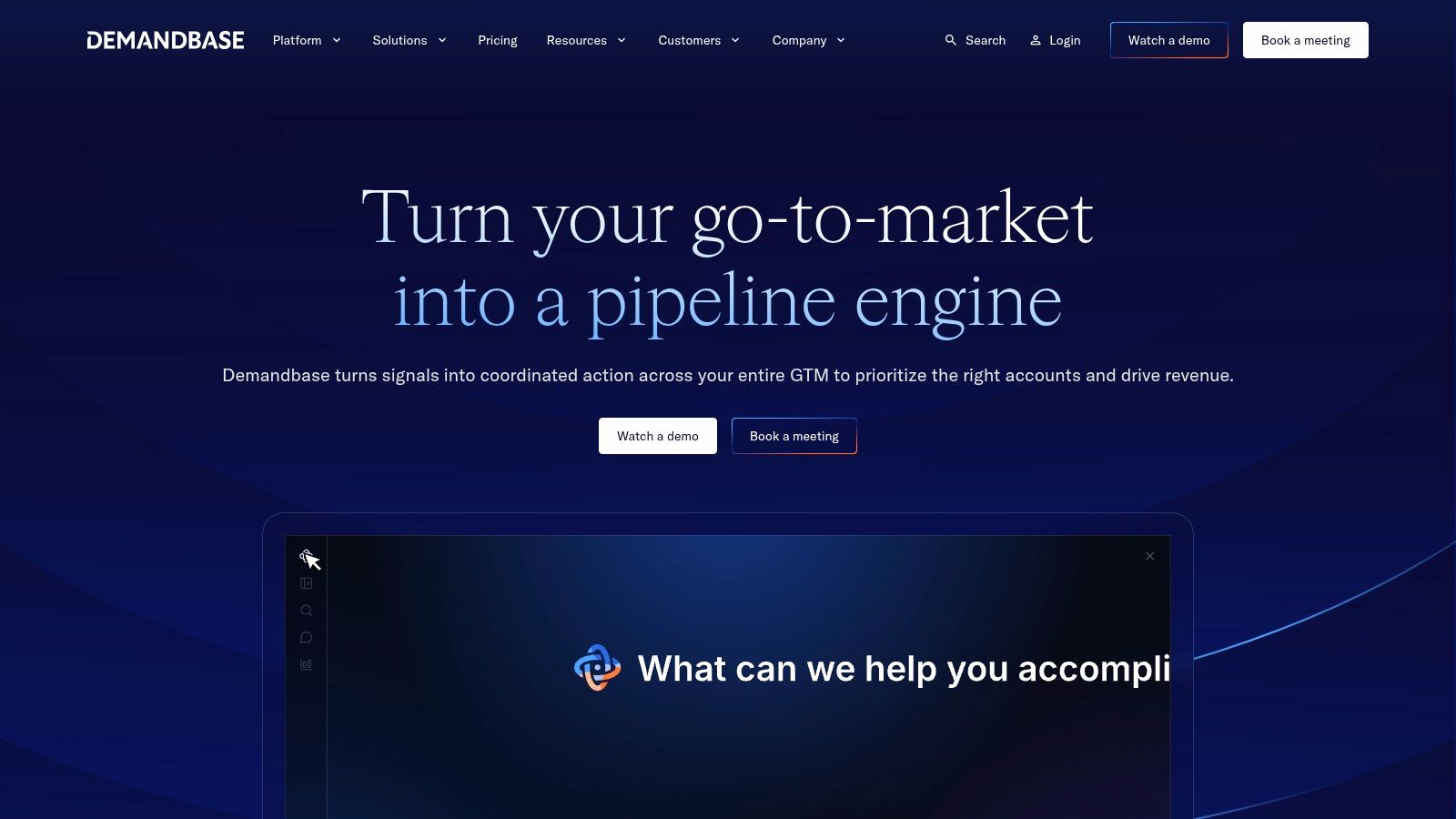
Demandbase One is another account-based GTM platform, but it leans hard into shared account visibility for sales and marketing. It unifies account identification, intent data, advertising, and sales insights, which makes it attractive for teams trying to eliminate the split between demand generation and field execution Demandbase. That alignment matters when multiple teams are influencing the same buying group.
Good when sales and marketing need one account view
Demandbase works best when you care about audience building, journey analytics, and a single account picture across channels. The integration with tools like Sales Navigator and G2 helps teams connect external research with internal routing, and the modular structure makes it easier to scope capabilities than in some all-or-nothing enterprise suites.
The downside is that it’s still an enterprise platform with enterprise expectations. Quote-only pricing and module selection can get expensive or bloated if the team only wants one slice of the stack. If you’re standardizing account-based go-to-market across functions, it’s strong. If you just need better contact data, it’s too much.
7. Cognism
Cognism is the cleanest fit for teams that need compliance-aware contact data, especially in Europe. It emphasizes GDPR-compliant workflows and phone-verified mobile coverage, which makes it relevant for EMEA prospecting where data quality and regulatory posture both matter Cognism. In practical terms, it serves a different job than a pure intent tool, it helps reps reach the right people reliably.
Built for Europe-heavy outbound
The platform’s main value is trust in the data path. Teams that rely on mobile outreach and need stronger European coverage tend to care less about vanity database size and more about whether a number is usable and whether the workflow respects privacy expectations. Cognism positions itself well there.
The limitation is cost and geography. Quote-only pricing, possible five-figure annual spend, and weaker US coverage compared with US-centric databases mean it’s usually a better choice for EMEA-first motions than for global teams that mostly sell in North America. If your pipeline lives in the UK, DACH, or broader Europe, that trade-off can be worth it.
8. Clearbit
Clearbit is strongest when your stack already runs through HubSpot and you want native enrichment without a lot of integration glue. It’s now embedded in HubSpot’s Data Hub, and its role is straightforward, enrich company and contact data, identify anonymous visitors, and reduce form friction inside a native environment Clearbit. That makes it a workflow tool more than a standalone prospecting destination.
Best for native enrichment inside HubSpot
The advantage is simplicity. If your CRM is already HubSpot, Clearbit can feed company and contact enrichment directly into objects and workflows, while Reveal helps identify anonymous traffic and trigger follow-up. That removes a lot of hand-built plumbing and keeps data closer to where reps work.
The downside is that it’s no longer a standalone pricing story, and that can make evaluation less transparent. Some teams also find that stale fields or creeping costs become an issue if governance is weak. It’s a good fit when HubSpot is already the center of gravity, less so when you need a broader, multi-system intelligence layer.
9. Bombora
Bombora is the purest company-level intent provider on this list. It surfaces topic-level research activity through its Company Surge model, which means it’s useful when you want to know which accounts are heating up before you know exactly who to call Bombora. That makes it a strong feed for ABM, prioritization, and account routing.
See the workflow distinction in this piece on intent signals versus static lists.
Strong when topic intent matters more than contacts
Bombora’s biggest advantage is that it gives you a signal layer you can plug into existing systems. Teams often layer it into CRMs, ABM platforms, and ad stacks because it helps prioritize accounts without forcing a full platform change. The methodology is also relatively well understood, which matters when buyers need to trust the signal before they reorganize workflow around it.
The catch is that it’s company-level, not person-level. If you need the next action to be a direct outreach message, you still need contact discovery and qualification downstream. Bombora is best when you use it to narrow the field before you ask a rep to engage.
10. UserGems
UserGems is built for one of the most valuable signals in sales, the job change of a past champion. It tracks champions and influencers as they move, ingests multiple signals, and can combine third-party account intent with retroactive job-change lead generation UserGems. That makes it especially useful for reopening warm doors, which is often easier than creating fresh ones.
Best for champion reactivation
The reason UserGems is so effective is simple. A contact who already knows your product, or who advocated for you at a previous company, is usually much closer to productive conversation than a cold name pulled from a database. Tracking those moves turns what would otherwise be churn into a fresh pipeline opportunity.
The trade-off is scope. It’s not a broad contact database, and ROI depends on whether your ICP contains enough past users or champions to make job-change tracking meaningful. When paired with enrichment or another data provider, though, it adds a very high-impact trigger layer.
Top 10 Sales Intelligence Tools Comparison
| Product | Unique features ✨ | Target audience 👥 | Quality ★ | Pricing & value 💰 |
|---|---|---|---|---|
| LeadBeast 🏆 | Signal stacking; living audiences; moment‑matched AI outreach; safety‑first pacing | B2B SaaS founders, VPs Sales, SDR/BDR leads, agencies, startups | ★★★★☆, strong connect/reply (30–60% / 20–55%) | Essential $99/mo; Pro $237/mo; Business $483/mo; 7‑day free trial |
| ZoomInfo SalesOS | Large NA contact db; org charts, technographics, “Scoops” | Mid‑market & enterprise sales/ops teams | ★★★★☆, deep data & integrations | 💰 Quote-only; seat minimums & credit add‑ons can raise cost |
| Apollo.io | Database + enrichment; AI-assisted prospecting; sequences; visitor ID | SMB → mid‑market reps and growth teams | ★★★★, fast setup; ongoing AI features | 💰 Transparent self-serve pricing; credits for advanced features |
| LinkedIn Sales Navigator | Native LinkedIn graph; real‑time activity alerts; saved lists | SDRs/reps using LinkedIn; relationship-led GTM teams | ★★★★☆, unmatched LinkedIn signals | 💰 Per-seat tiers; Advanced/Enterprise features quote-only |
| 6sense Revenue AI | Predictive buying-stage scoring; multi‑channel orchestration | Enterprise ABM & revenue orchestration teams | ★★★★☆, robust ABM workflows | 💰 Quote-only; typically high; implementation effort required |
| Demandbase One | Full-stack ABM + intent, ads & journey analytics | Enterprise cross-functional sales + marketing teams | ★★★★, consolidated ABM view | 💰 Quote-only; modular fees; can be cost-prohibitive |
| Cognism | GDPR-focused EMEA coverage; phone-verified “Diamond Data” | Europe-heavy outbound teams (UK, DACH, EMEA) | ★★★☆☆, strong EU phone data; US lighter | 💰 Quote-only; mid-market often reports five-figure costs |
| Clearbit | HubSpot-native enrichment & Reveal; credit-based Reveal | HubSpot-centric teams wanting native enrichment | ★★★☆☆, clean HubSpot experience | 💰 Pricing through HubSpot; credit-based metering |
| Bombora | Company Surge topic intent; partner integrations & dashboards | ABM teams prioritizing accounts for ads & outbound | ★★★☆☆, well-documented company-level intent | 💰 Quote-only; value depends on topic curation |
| UserGems | Job‑change tracking of past champions; person-level triggers | Teams re-engaging past champions & churned buyers | ★★★★, high-leverage warm outreach | 💰 Quote-only; ROI depends on champion volume in ICP |
Build a Signal-to-Conversation Stack
The best way to buy sales intelligence tools is to map each one to a single signal and a single workflow. If you want LinkedIn-native person-level activity, choose LeadBeast or LinkedIn Sales Navigator. If your priority is contact coverage and enrichment, choose ZoomInfo, Apollo, or Cognism. If you need account-level intent and ABM orchestration, choose 6sense, Demandbase One, or Bombora. If your stack is already anchored in HubSpot, Clearbit makes more sense than a standalone enrichment layer, and if your growth motion depends on previous champions changing jobs, UserGems is the sharper choice.
A common mistake is buying for breadth and hoping workflow will follow. Instead, define one trigger, one owner, one destination system, one response window, and one success metric before you sign anything. A job change should trigger a different play than a pricing-page visit, and a company-level surge should not be handled the same way as a LinkedIn comment from a target account.
Implementation complexity starts to matter more than feature lists here. A platform with excellent data but poor adoption will underperform a simpler tool that reps use every day. Category-wide evidence supports this view, as adoption, integration quality, and trust in the data are now the key blockers, not basic awareness of the software itself adoption and integration overview.
Keep the stack narrow enough to run. Use person-level triggers when timing matters, account-level intent when coverage matters, and enrichment when reachability matters. The highest-performing teams don’t chase the largest database, they build a stack where signal quality, ICP definition, workflow adoption, and follow-up discipline all point in the same direction.
LeadBeast helps B2B teams turn LinkedIn activity into a live sales signal, then qualifies those people and companies against a defined ICP before automating the next step. If you want a sales intelligence workflow built around real buying intent instead of static lists, visit LeadBeast and see how it fits into your outreach stack.