Intent based marketing means contacting an account when observable evidence points to an active business need, rather than following a static list on a schedule. Organizational changes, such as growth, restructuring, new leadership, or shifting priorities, can create that need. The signal is a reason to pay attention, not proof that someone is ready to buy.
That distinction changes how marketing and sales use intent data. A spike in research activity may come from someone who is still exploring, so treating every spike as a prompt to reach out can interrupt buyers too early. Instead, check whether signals support one another and whether the account fits. When evidence is weak, keep monitoring rather than sending an alert or message.
The strongest system may produce fewer alerts. Restraint is the skill: set a clear threshold for when evidence justifies human review or outreach, and let weaker signals accumulate before acting. That way, teams can focus attention where there is a credible reason to start a conversation.
Table of Contents
- What Intent-Based Marketing Actually Means
- Where Buying Intent Signals Come From
- Stacking Signals Into Account-Level Intent
- Separating Curiosity From Buying Momentum
- How to Orchestrate Outreach Across the Buying Journey
- Three B2B Examples From Signal to Conversation
- Confirm Your Intent Setup Before You Automate
What Intent-Based Marketing Actually Means
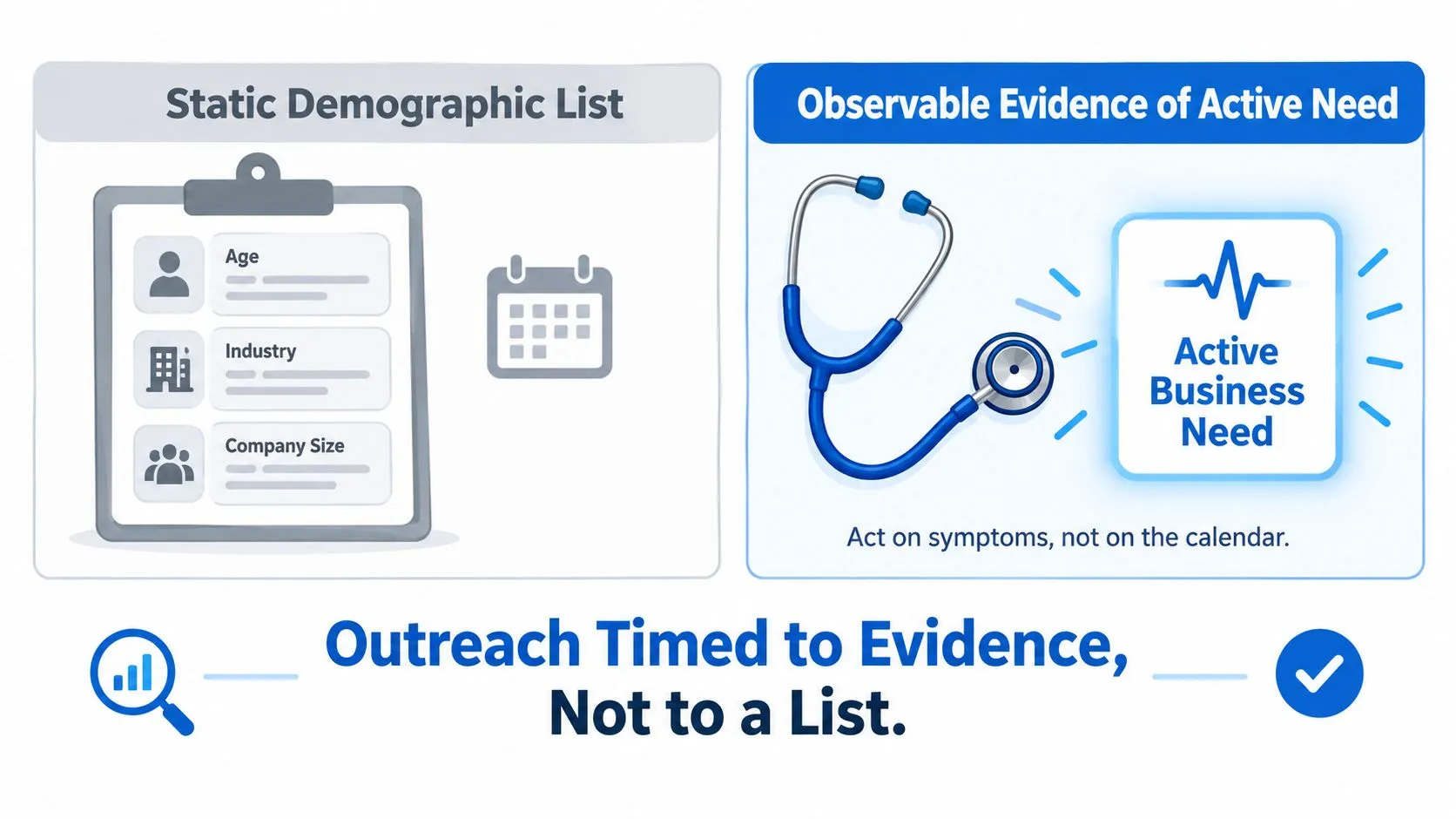
In short, intent based marketing is outreach timed to observable evidence of an active business need, not to a static demographic list. Think of a doctor. A good doctor doesn’t prescribe treatment because a calendar reminder appeared. She acts on symptoms, checks them against the patient’s history, and chooses a response that matches what she sees in front of her. Marketing works the same way here. The symptom comes first. The response follows.
Why timing beats list size
According to Gartner’s guide to the B2B buying journey, 99% of B2B purchases are driven by organizational changes, such as growth, restructuring, new leadership, or evolving business priorities. That single fact explains why timing matters more than list size. A perfect-fit account with no internal change has no reason to buy this quarter. A similar account that just hired a new leader or restructured a team may have a live problem and a new budget owner. Your message lands completely differently in those two situations.
Gartner also describes six recurring buying jobs that buyers cycle through as they purchase. Naming them helps you read signals correctly:
- Problem identification: The team agrees something is broken or missing.
- Solution exploration: They look at categories and approaches, not vendors yet.
- Requirements building: They define what a solution must do.
- Supplier selection: They compare specific vendors against those requirements.
- Validation: They test whether claims hold up, often with trials or references.
- Consensus creation: They get internal agreement to proceed.
These jobs don’t run in strict order. A team can reach supplier selection, discover a new requirement, and loop back. That’s why a single fixed nurture sequence misses buyers. It assumes a straight line that real buying groups don’t follow.
The three-part model
Everything in this guide uses one simple structure. First, a signal, which is an observable action like a relevant LinkedIn comment, a role change, or engagement with a competitor’s content. Second, a context check, which asks whether the account fits your ideal customer profile and whether the person holds a relevant role. Third, a response matched to the evidence, which might be outreach, education, or deliberate silence. If you can explain those three parts to a colleague, you understand the concept. The rest is calibration.
Where Buying Intent Signals Come From
A signal is any observable action that suggests a business need. Its strength depends on what the action reveals about the buyer, not on how easy it is for you to capture. This distinction trips up many teams. A signal you can collect automatically, like a topic surge from a data vendor, feels solid because it arrives in a neat dashboard. But neatness isn’t evidence. A pricing question asked in a live conversation is messy and manual, yet it tells you far more.
Eight sources, ranked by what they reveal
| Signal source | Example | What it suggests | Indicative strength |
|---|---|---|---|
| Direct sales conversation | Demo request or pricing question | Explicit evaluation under way | Very high |
| Role and job change | New VP of Sales or Head of Growth at a target account | New priorities and a new budget owner | High when the role fits the ICP |
| Company organizational event | Funding round, sales hiring spree, restructuring | Business change driving a need | High |
| Competitor engagement | Commenting on a rival’s posts or content | Comparing alternatives | Medium to high |
| First-party site behavior | Repeat visits to integration or pricing pages | Active research on your domain | Medium to high |
| Keyword and content research | Reading comparison pages on a problem category | Problem recognition or solution exploration | Medium |
| LinkedIn engagement | Commenting on a category post or reacting to thought leadership | Interest, possibly from a relevant role | Low to medium |
| Third-party topic surge | Account shows rising research across publishers on a topic | Early research at company level | Low |
How to read this table
Look at what separates the top rows from the bottom ones. High-strength signals connect to a decision-maker or a business change. A new VP of Sales brings new priorities. A funding round or a sales hiring spree creates problems that need solving now. You can read more about this pattern in this guide to hiring signals for RevOps teams, which shows how hiring activity reveals operational needs before anyone visits your site.
Weak signals, by contrast, show attention without commitment. A single LinkedIn like might mean agreement, politeness, or professional networking. A third-party topic surge tells you someone at the company is reading about a subject, but you don’t know who, why, or whether a budget exists. Neither justifies a sales message on its own.
Working rule: A signal earns outreach when it reveals a problem, a person who owns that problem, or a change that makes the problem urgent. Attention alone earns monitoring.
Treat the strength labels as working judgments for prioritizing, not statistical benchmarks. Your market may behave differently. Calibrate the labels against your own conversion history. If competitor engagement from Heads of Growth consistently produces replies in your data, promote it. If repeat pricing page visits rarely convert, demote them. The table is a starting order, not a law.
One more caution. First-party behavior, like repeat visits to your integration pages, sits in the middle for a reason. It’s real research on your domain, which matters. But researchers compare several vendors at once, so a visit means you’re in a consideration set, not that you’ve won a place in a final evaluation. Respond with useful content, not a meeting request.
Stacking Signals Into Account-Level Intent
Single signals mislead. Signal stacking fixes this by combining several actions into one picture, so you judge the pattern rather than the isolated event. The visual below shows how person-level activity rolls up into an account-level judgment.
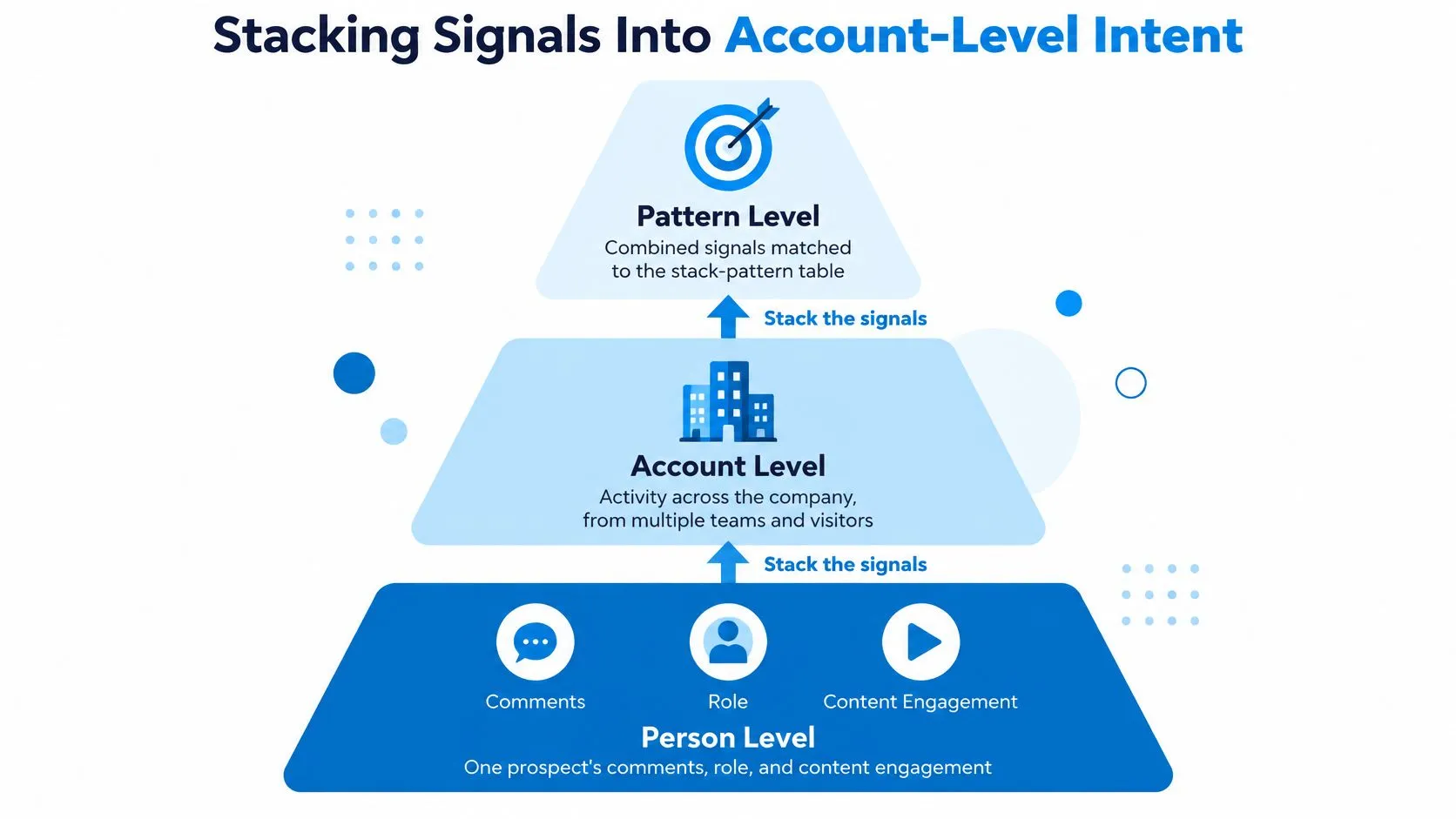
Stacking works at three levels. At the person level, you look at one prospect’s comments, role, and content engagement. At the account level, you look across the whole company, including hiring, funding, and activity from multiple employees. At the buying-group level, you ask whether the people who would influence this decision are showing activity, not just anyone with a company email address.
That third level matters because B2B purchases are rarely solo decisions. In Forrester research reported in 2021, 94% of revenue professionals sold to groups of at least three people, and 38% sold to groups of 10 or more. In a separate Forrester survey of buyers considering solutions costing more than $5,000, three or more people participated in the decision 84% of the time. So one engaged contact is a lead. Several engaged contacts in relevant roles is evidence an account is moving.
A worked example
Say a Head of Growth at a target account comments on a LinkedIn post about outbound reply rates. Alone, that’s noise. She might know the author. Now add context. Within the same 30 days, she also engages with a competitor’s content, and her company posts two new sales roles. The account fits your ICP on size and industry. That’s no longer a comment. That’s a growth leader, at a hiring company, weighing alternatives in your category. The stack justifies a relevant, personalized message. The single comment never did.
This short video walks through how stacked signals change prioritization in practice.
Segment before you stack
Stacking only counts when the account fits your target profile, so split your account universe into audiences before you read any signal. Segment first by ICP tier, so high-fit accounts get full stack rules while adjacent accounts get monitoring only. Segment second by buying role, so a Head of Growth, a finance approver, and an IT reviewer each have separate trigger rules and messages. Segment third by buying stage, using the stack pattern to label each account as researching, comparing, or evaluating. If you run outreach for multiple clients or products, keep a separate ICP and audience for each one, so one segment’s signals never trigger another’s sequence.
Separating Curiosity From Buying Momentum
Most intent programs fail at one specific point. They treat a page view, a keyword search, a social like, or a third-party spike as a reason to contact someone immediately. The buyer was researching in private. Your message arrives referencing behavior they didn’t share with you. It feels like surveillance, and it burns the account before a real evaluation even starts.
Buyers have been clear about how they want this to work. Gartner’s 2025 sales survey found that 61% of B2B buyers prefer an overall rep-free buying experience, while buyers still prefer seller input for contextual tasks such as determining whether a solution fits their company’s needs. Read that carefully. Buyers aren’t rejecting sellers. They’re rejecting sellers who show up before there’s a fit question to answer. Digital behavior should raise your confidence only when it combines with context, namely ICP fit, role relevance, repeated activity, business change, and an observable problem. Structured qualification fills that gap, and this walkthrough on how to build a B2B lead qualification process shows how to formalize those checks before sales gets involved.
Thresholds that turn judgment into a rule
| Stack pattern | Likely meaning | Right action | Avoid |
|---|---|---|---|
| One weak signal, poor ICP fit | Curiosity or peer research | Monitor only | Any outreach |
| Strong signal, poor ICP fit | Interest outside the target market | Share general content or nothing | Sales sequence |
| Two signals from one relevant role | Early research | Educational touch with a relevant resource | Meeting request or pitch |
| Three or more signals across roles, including a decision-maker | Evaluation may be starting | Personalized outreach tied to the trigger | Generic sequence |
| Role change or funding plus competitor engagement | Organizational change plus alternatives being weighed | Human review, then priority outreach | Fully automated messages without review |
| Explicit buying question or demo request | Active evaluation | Sales conversation now | Nurture sequence |
Notice the first row. It’s arguably the most valuable one in the table. Monitor only is a deliberate decision, not a missed opportunity. Every weak-fit account you don’t contact protects your sender reputation, your team’s time, and your credibility when that account’s situation changes later.
The middle rows are where scoring discipline pays off. If you need a refresher on weighting behaviors, this explainer on what lead scoring is and how to build a model covers how to assign values that reflect evidence rather than activity volume. The principle stays the same whatever model you use. Two signals from one relevant person means early research, so send something educational. Three or more signals across roles, including a decision-maker, means an evaluation may be starting, so personalized outreach tied to the actual trigger is appropriate.
A well-run intent system often generates fewer alerts than a noisy one, and that’s a sign it’s working.
The last two rows deserve human attention. A role change plus competitor engagement is your strongest non-explicit pattern, and it’s exactly where a careless automated message does the most damage. Have a person review the context first. And when someone asks a pricing question or requests a demo, don’t put them in a nurture sequence. They’ve told you what they need. Start the conversation.
How to Orchestrate Outreach Across the Buying Journey
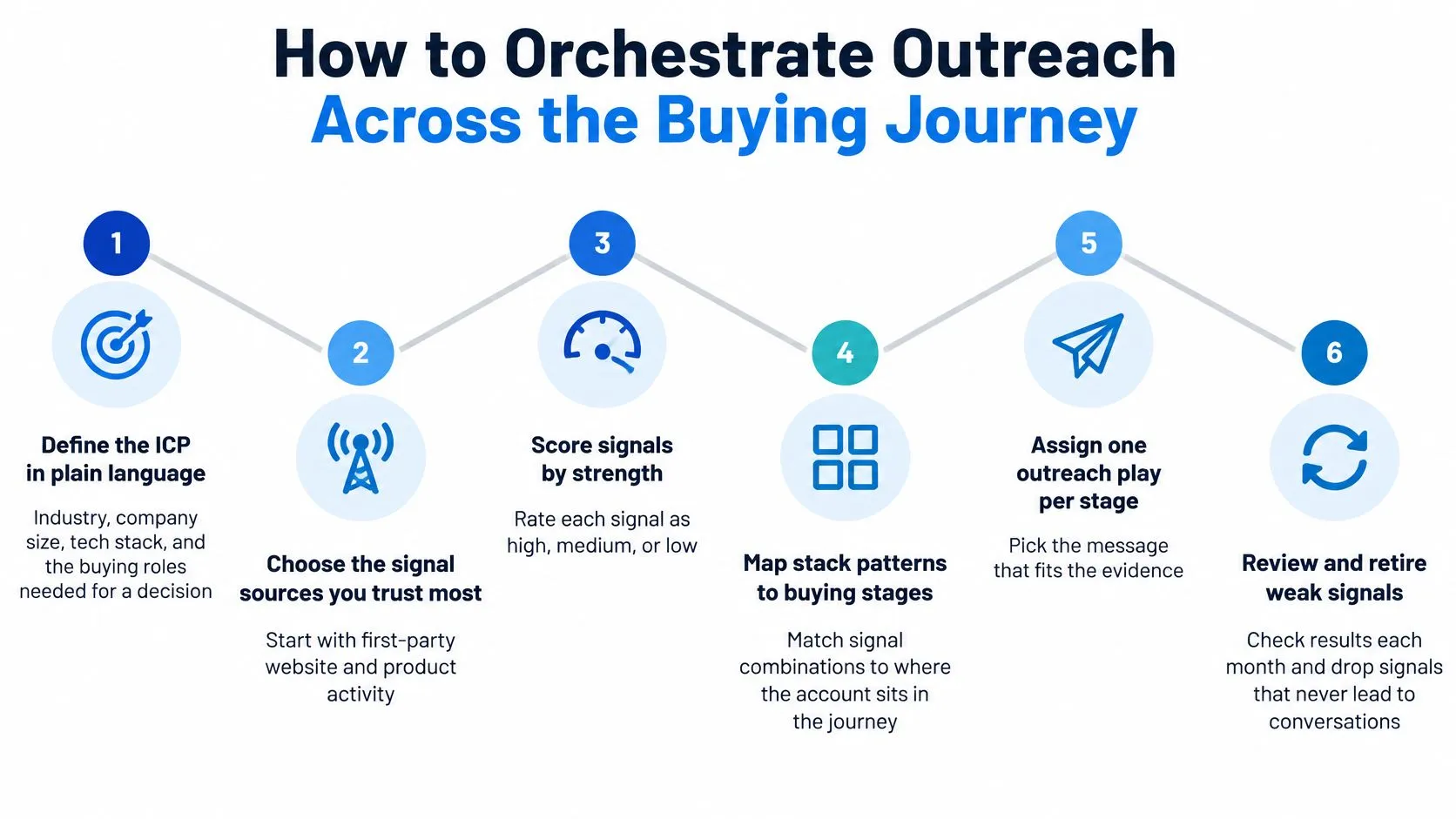
Orchestration gives each signal pattern a defined response, a clear owner, and a shared record. The stakes are significant: Forrester’s State of Business Buying 2024 reported that 86% of B2B purchases stalled during the buying process, while 81% of buyers expressed dissatisfaction with their chosen provider. Those figures describe the buying experience, not the cause. A disciplined outreach process helps teams respond with relevant context rather than add avoidable confusion.
The six steps
-
Define the ICP in plain language. Specify the industry, company size, tech stack, and buying roles involved in a decision. If a new hire cannot use the definition to sort ten accounts consistently, tighten it before building audiences.
-
Choose signal sources you trust. Begin with high-strength sources such as role changes and company events. Add competitor engagement and repeat site visits only after your own conversion data supports using them. Starting with too many sources can create alerts that require more review than your team can handle.
-
Set stacking rules with a time window. Combine person-, account-, and buying-group activity over a defined period, such as 30 days. Let older signals expire. A comment from last quarter may no longer reflect this quarter’s priorities.
-
Add a review gate for mid-strength patterns. Have a person check the context before outreach goes out. Review is useful when the role is uncertain, the trigger may be stale, or a message could sound as if you are monitoring someone too closely. If the pattern is weak or unclear, keep monitoring instead of sending.
-
Personalize to the trigger. Refer to the role change, post, or competitor context that prompted contact. A first name and company name alone do not explain why you are reaching out now. The message should connect the observed signal to a relevant conversation.
-
Pace and suppress. Set a sending cap for each sender, add delays between touches, and stop the sequence as soon as a prospect replies. Keep replies in one inbox and conversations in one CRM record so context is not split across tools. A sales engagement platform can help coordinate those tasks.
Two guardrails that aren’t optional
First, follow platform terms and local consent rules, including GDPR requirements for EU contacts and clear email opt-outs. A public LinkedIn comment is a signal, not consent to add someone to an email sequence. Treating the two as equivalent creates legal and reputational risk.
Second, record the trigger on the CRM record for every contact you make. Note which signals stacked, when they occurred, and who approved the outreach. If a prospect complains or results disappoint, that record lets the team review the decision and adjust its thresholds. Without it, the reasons behind past outreach are difficult to reconstruct.
Three B2B Examples From Signal to Conversation
Theory only helps if it survives contact with a real pipeline. These three scenarios show the same rules producing three different outcomes.

The seed-stage founder
Say a seed-stage SaaS founder is launching her first outbound motion with no brand recognition and no SDR team. She defines a narrow ICP, then watches for just two high-strength signals, a new Head of Sales hire and a funding announcement. When both appear at the same account, she sends one personalized message referencing the hire and the specific problem a first sales leader usually inherits. She tracks the reply rate against a small cold-list baseline she ran first. The volume is tiny. That’s the point. With no reputation to protect her, relevance is her only asset, and the stack gives her a legitimate reason to write.
The agency with eight clients
Now say an agency runs LinkedIn outreach for eight B2B clients. The risk here isn’t weak signals. It’s crossed wires. The agency keeps a separate ICP definition and audience for each client, so a signal that matters for a fintech client never triggers a sequence for a logistics client. Mid-strength patterns across all accounts pass through one shared review step, where a strategist checks role fit and message context before anything sends. Clients see fewer total messages than a volume-based agency would promise. They also see replies that reference real triggers, which is what renews contracts.
The SDR team that alerted on everything
The failure case teaches the most. Say an SDR team at a mid-market tech company configures alerts on every LinkedIn like from a target account. Within a month, weak signals flood the queue. Reps can’t tell a genuine pattern from background noise, so they start ignoring alerts or sending rushed, generic messages. Sender accounts show risk from high-volume, low-relevance activity, and reply quality drops because most recipients were never researching anything. The fix isn’t better copy. It’s structural. The team raises the threshold to stacked patterns, adds the review gate, and deletes low-strength triggers entirely. Alert volume falls sharply, and the alerts that remain are worth a rep’s attention.
One finding explains why the first touch in all three cases leads with value rather than a meeting request. In HubSpot’s 2024 survey of B2B buyers, 75% of B2B buyers preferred to gather product information independently, and 57% purchased a tool without meeting the vendor’s sales team. Your first message competes with the buyer’s own research. If it only asks for time, it loses. If it adds context the buyer couldn’t easily find alone, it earns a reply.
Confirm Your Intent Setup Before You Automate
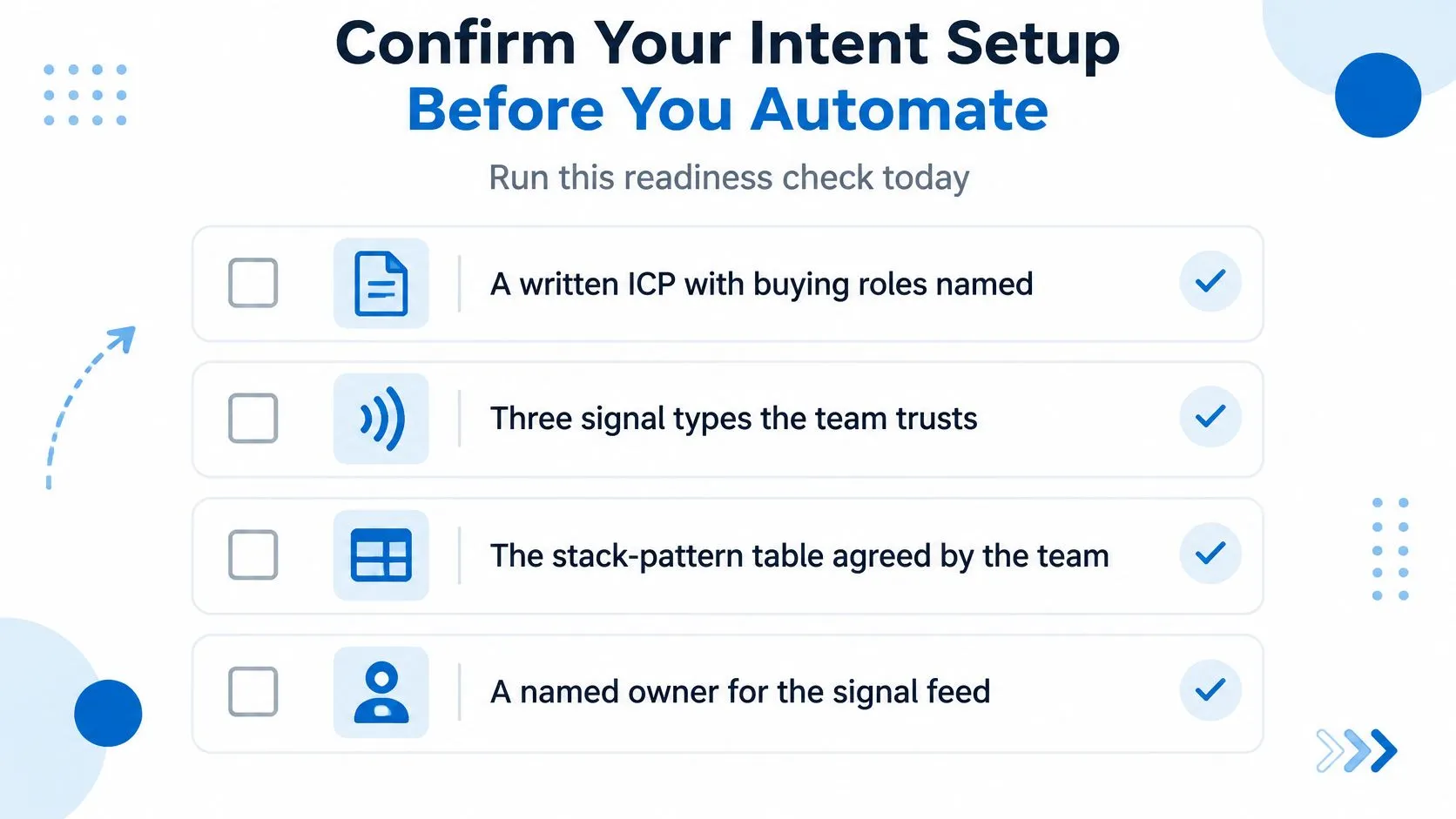
Automation multiplies whatever system you already have. If your thresholds are sloppy, it multiplies sloppy outreach at a speed no human team could match. Run this readiness check first.
The readiness checklist
- Written ICP: Your ideal customer profile exists on paper, with buying roles named.
- Three trusted signal types: You’ve picked the sources you’ll act on and excluded the rest.
- Agreed stack-pattern table: Your team has decided, in advance, which patterns mean monitor, educate, review, or contact.
- Named review gate owner: One person is accountable for checking mid-strength patterns before they send.
- Suppression rules: Sender limits, sequence stops on reply, and opt-out handling are configured, and you verify individual email addresses before any address enters a sequence, so bad data doesn’t damage deliverability.
- A recorded baseline: You know your current reply and acceptance rates before the first intent-based campaign runs.
Run a pilot before you widen scope
Test the setup on one ICP for four to six weeks. Compare results against your baseline, then apply one decision rule. If the pilot’s reply rate beats the baseline without a rise in unsubscribes or negative replies, widen the ICP by one segment. If it doesn’t, raise your thresholds before you change anything else. Tools such as LeadBeast can monitor LinkedIn signals, qualify accounts against a plain-language ICP, personalize messages to each trigger, and sync replies with CRM tools, but treat any tool as one option among several. Automation only works once the ICP and thresholds exist on paper. Bring this checklist to every vendor evaluation, whichever platform you eventually choose.
If your checklist is complete and you’re ready to put stacked LinkedIn signals, plain-language ICP qualification, and trigger-matched outreach into one workflow, visit LeadBeast to see how it turns buyer activity into relevant conversations. Start with one ICP, run your pilot, and let your own reply data set the thresholds.