Most advice about B2B lead generation on LinkedIn starts with the wrong question: how many connection requests can your team send each day? That metric encourages the exact behavior buyers have learned to ignore, generic invitations followed by an immediate pitch, automated compliments, and sequences with no relationship to the prospect’s priorities.
LinkedIn works better as a professional intent environment than as a digital phonebook. A profile view, like, or new connection might mean nothing on its own. A specific operational problem discussed by a target account, repeated engagement from several employees, and a relevant role change create a more credible reason to start a conversation. The shift is simple but demanding, from maximizing activity to interpreting context.
Table of Contents
- Why the Old Playbook is Failing
- The Evolution of Professional Data
- Decoding Intent Through Signal Stacking
- Crafting Context-Aware Outreach Sequences
- Building Dynamic and Living Audiences
- Adapting to AI-Mediated Buyer Journeys
- Integrating Signals into Your GTM Stack
Why the Old Playbook is Failing
The connect-and-pitch model assumes that access creates interest. It doesn’t. A prospect can accept a connection request because the sender looks relevant, then ignore every message that follows. The connection becomes a vanity metric while the sales team mistakes platform activity for pipeline movement.
Spray-and-pray outreach also removes the most valuable part of LinkedIn, the context around a person’s professional life. A generic message doesn’t use the prospect’s role, company situation, public questions, or current priorities. It asks the buyer to do all the work of figuring out why the conversation matters.
Practical rule: If you can’t explain why this person should care today, don’t automate the message yet.
Volume creates the wrong incentives
High-volume campaigns reward send counts, acceptance rates, and reply totals. Those measures can hide weak commercial outcomes. A positive reply may be polite. An accepted request may never become a conversation. Even a conversation can be irrelevant if the account doesn’t match your ideal customer profile.
LinkedIn Marketing Solutions cites Wpromote’s State of B2B Marketing Report, which found that 89% of B2B marketers use LinkedIn for lead generation, while 62% say it generates leads for their organizations. The reported lead-generation rate was more than twice that of the next-highest social channel, but adoption doesn’t prove qualification or timing. The data supports LinkedIn as a priority channel, not as a justification for indiscriminate outreach. LinkedIn’s lead-generation benchmarks provide useful context for that distinction.
The more durable alternative is intent-led prospecting. Instead of asking how many people can be contacted, ask which accounts are showing a pattern that makes outreach useful. A leader describing a problem, colleagues responding to related content, and a timely organizational change may justify a message. A single like usually doesn’t.
Relevance beats arbitrary quotas
This doesn’t mean every message must become a handcrafted research project. It means automation should begin after qualification, not before it. Define the account and role you want, monitor observable activity, combine signals, and trigger a conversation only when the evidence is specific enough.
For teams designing a broader acquisition system, Crescade’s guide to strategies for measurable B2B growth is a useful companion because it places LinkedIn within a measurable growth motion rather than treating it as an isolated outreach trick.
The commercial trade-off is clear. A signal-led system may contact fewer prospects, but each message has a stronger reason to exist. That improves the quality of sales conversations and protects the sender’s reputation from a stream of irrelevant pitches.
The Evolution of Professional Data
LinkedIn’s value comes from more than its audience size. It combines professional identity with public activity, giving B2B teams a way to connect a person’s role, employer, industry, career history, and visible interests. That structure is far more useful for prospecting than anonymous website traffic, where a visit often reveals little about the person or account behind it.
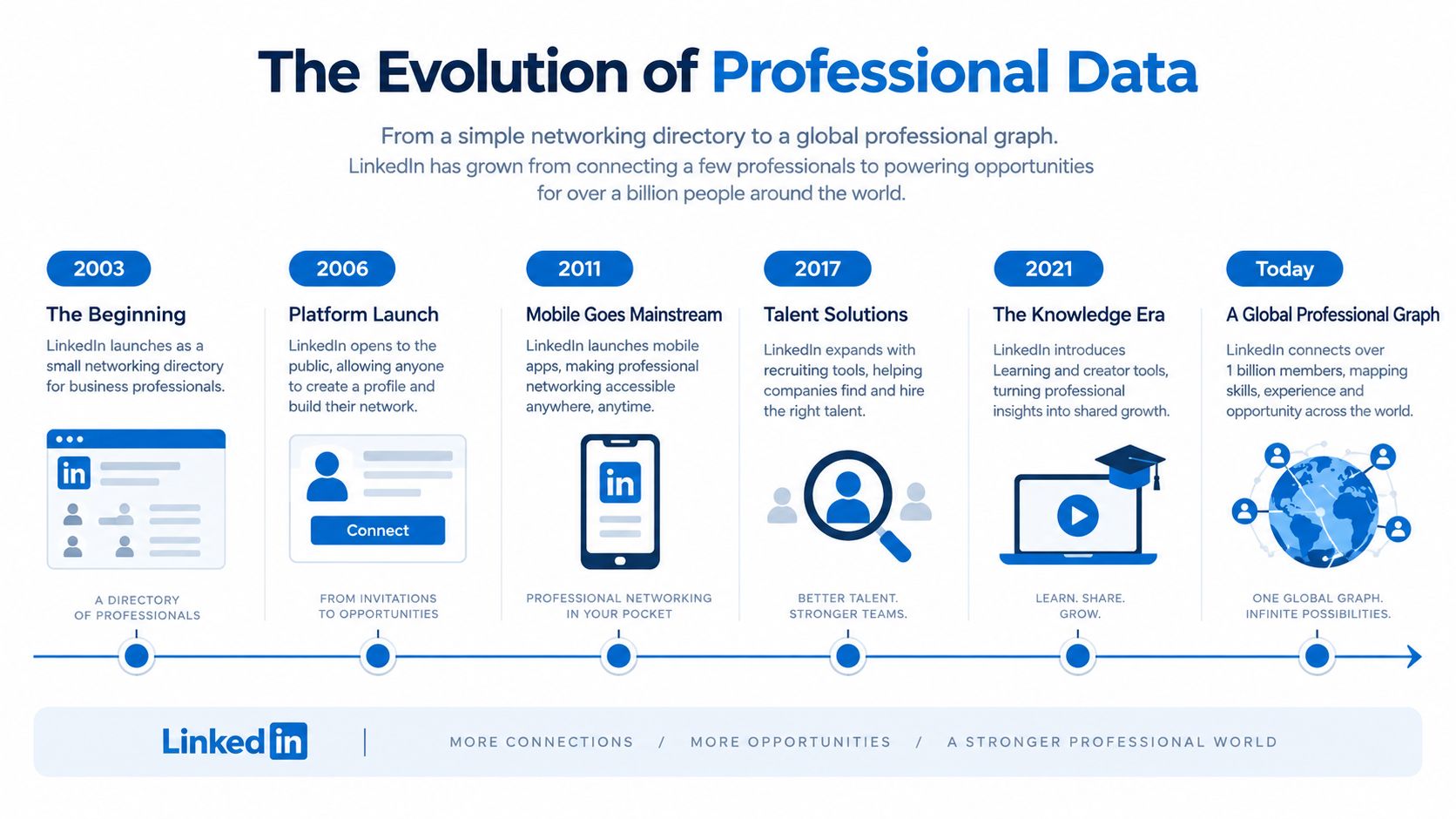
The platform launched on May 5, 2003, and had approximately 4,500 members after its first month. By November 2003, membership had reached about 37,000, and after two years it exceeded 1.7 million registered users. LinkedIn passed 100 million members in 2011, exceeded 225 million members by its tenth anniversary in 2013, and reached approximately 1 billion registered users in 2024, according to the historical milestones summarized in this LinkedIn growth reference.
Scale is useful only with professional context
That trajectory changed the platform from a small networking directory into a global professional graph spanning more than 200 countries and territories. For B2B teams, scale supports account discovery, role-based targeting, relationship mapping, and monitoring of public professional activity.
A registered-member total still isn’t a buyer-intent count. LinkedIn hasn’t consistently disclosed daily or monthly active-user figures, and a registered account may not represent current activity, authority, or purchase readiness. Treating the headline total as available demand leads to inflated expectations.
The useful layer sits underneath the audience total:
- Identity: The profile can connect a person to a role, employer, career history, and professional interests.
- Structure: Company and role information helps teams map multiple stakeholders within an account.
- Activity: Posts, comments, role changes, and engagement can provide observable context.
- Qualification: Firmographic and person-level evidence can determine whether outreach fits the ICP.
The platform’s evolution matters because it gives sales teams more than reach. It gives them a public context in which timing and relevance can be assessed. Raw scale is only the foundation. Pipeline quality depends on how carefully a team converts that context into a qualified conversation.
Decoding Intent Through Signal Stacking
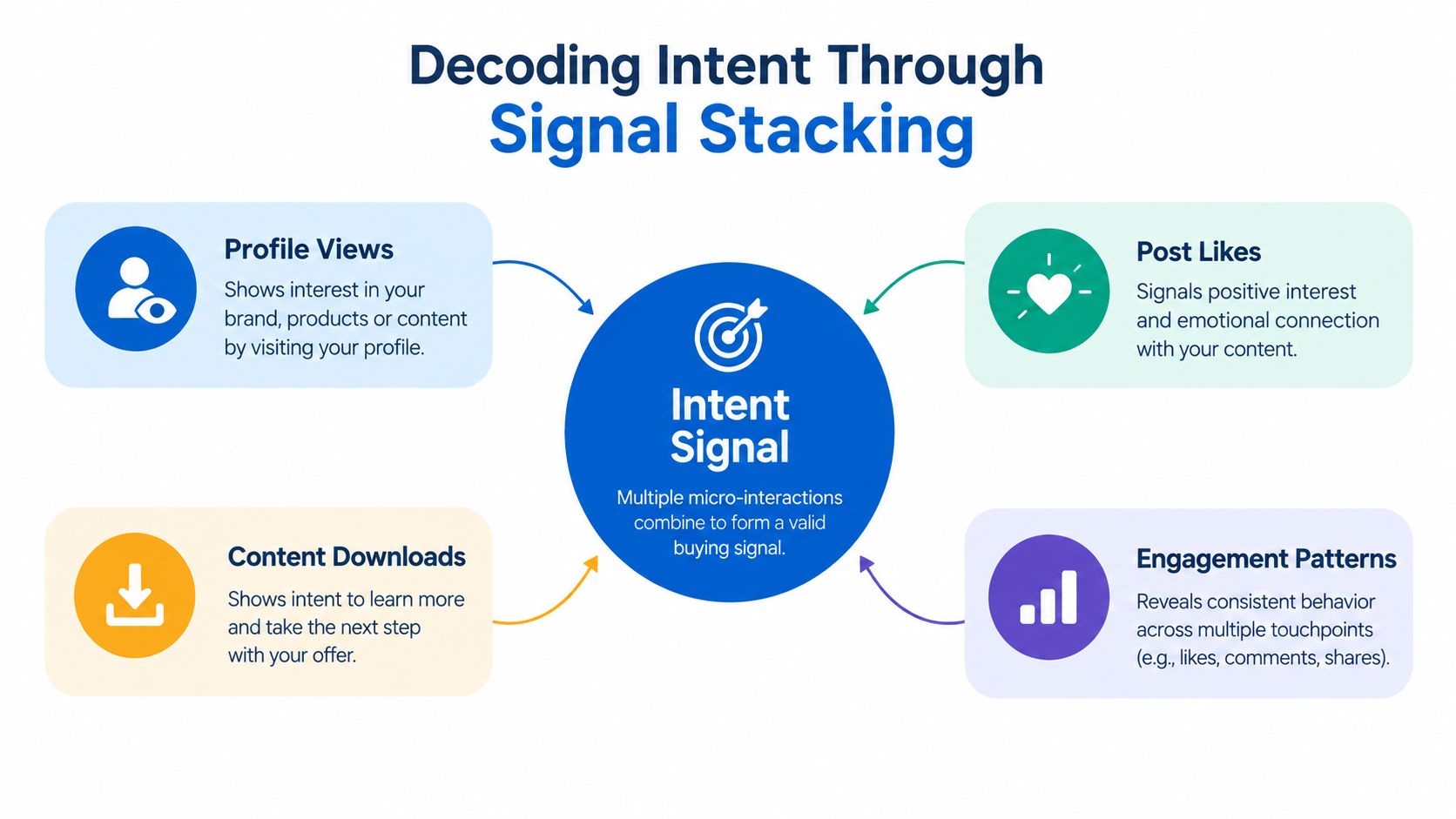
A single LinkedIn interaction is usually weak evidence. A profile view might reflect curiosity, research, or an accidental click. A like may acknowledge a point without indicating a business problem. Treating either as a buying signal creates false positives and fills the pipeline with people who were never evaluating a solution.
Signal stacking solves that problem by combining several observable behaviors and judging them against the account, role, and timing. The approach isn’t about collecting every available data point. It’s about finding a coherent pattern that supports a relevant next step.
Four filters for stronger signals
Start by evaluating each behavior through four filters:
- Recency: A recent action usually deserves more attention than an old one. Timing matters because the buyer’s priorities can change quickly.
- Specificity: Engagement with a post about a concrete operational challenge is more informative than a reaction to general career content.
- Role relevance: A signal from someone who owns the affected function carries more weight than one from an unrelated role.
- Account repetition: Similar activity from several people at the same company is stronger than isolated behavior from one individual.
Consider an account where a revenue leader discusses inconsistent pipeline quality, two sales managers engage with related content, and the company is visibly hiring for a role connected to outbound execution. None of those actions proves an active buying process. Together, they create a defensible reason to research the account further and prepare a message that addresses the stated problem.
A practical scoring model can use qualitative tiers rather than pretend to produce scientific certainty:
| Signal quality | Typical pattern | Recommended action |
|---|---|---|
| Weak | One generic like or isolated profile view | Keep in nurture |
| Developing | Relevant post engagement from an ICP-matched person | Monitor for another signal |
| Stronger | Specific problem, role relevance, and repeated account activity | Research and prepare outreach |
| Priority | Several aligned signals across people or time | Start a context-aware conversation |
Don’t use personal data beyond what is necessary for a professional interaction. The objective is to interpret public business context, not infer private motives. A signal should make the message more relevant, not more invasive.
More guidance on separating behavior from static contact records is available in intent signals versus static lists. The distinction is central to responsible automation because a list describes who someone is, while a signal can suggest why a conversation might be timely.
A strong operating rule is to require at least two dimensions of evidence, such as specificity plus role relevance, or recent activity plus account repetition, before triggering outbound action. The exact threshold should reflect your sales cycle and tolerance for false positives.
The following video offers another visual perspective on how activity can inform B2B prospecting:
Crafting Context-Aware Outreach Sequences
Once a signal earns attention, the message has one job: make the reason for contact obvious without overstating what you know. Personalization tokens such as a first name, company name, or job title don’t create relevance by themselves. The message should connect the observed trigger to a plausible business issue and offer a low-friction way to continue.
Write to the moment, not the profile
A useful first message has three parts:
- The trigger: Refer to the relevant public post, role change, hiring pattern, or category discussion.
- The implication: Show that you understand the operational issue without claiming certainty about the buyer’s internal plans.
- The permission-based next step: Ask a focused question or offer a relevant resource rather than forcing a meeting.
For example, if a sales leader publicly discusses poor lead quality, a message can acknowledge that challenge and ask how the team currently separates buying interest from casual engagement. It shouldn’t jump straight to a product pitch or pretend that one post confirms an active project.
AI can help draft variations, classify triggers, and maintain message consistency. It shouldn’t replace judgment about whether the signal is strong enough, whether the sender has credible expertise, or whether the timing is appropriate. Human review remains especially important when a message refers to sensitive organizational changes or a prospect’s public frustrations.
Sequence for conversation quality
A context-aware sequence usually works better when each step adds value instead of repeating the same ask:
- Opening: State the specific reason for reaching out and ask one relevant question.
- Follow-up: Add a practical observation, framework, or proof point connected to the trigger.
- Nurture: If there’s no response, wait and continue with useful content rather than escalating pressure.
- Exit: Close the sequence respectfully when the context no longer supports contact.
Use human-like pacing and avoid bursts that make automation obvious. Warm engagement, such as reading and responding thoughtfully to relevant content, can support credibility, but it shouldn’t become performative activity designed solely to manipulate a prospect into accepting a request.
For a broader treatment of LinkedIn lead generation that converts, compare the message mechanics with the qualification and follow-up logic behind your own motion. The strongest sequences align the offer, the trigger, and the buyer’s stage.
Teams building the broader prospecting process can also review LinkedIn for prospecting to connect profile research, signal monitoring, and outreach execution. The central principle remains unchanged: automation should scale relevance, not manufacture familiarity.
Building Dynamic and Living Audiences
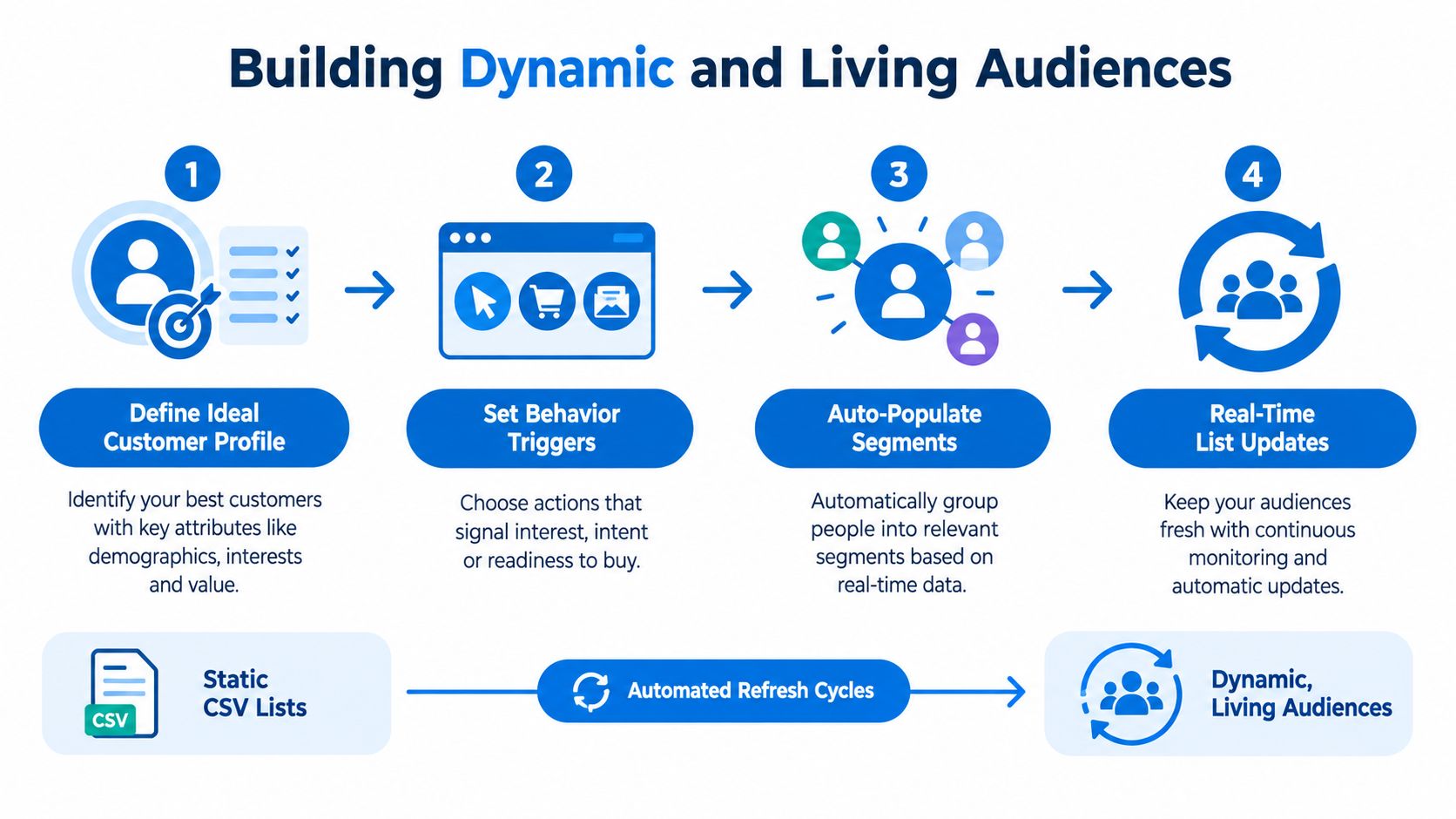
A static CSV is already losing relevance when someone exports it. People change roles, companies hire new leaders, accounts alter priorities, and prospects move from passive research to active evaluation. A list that doesn’t refresh can keep sending messages after the reason for contact has disappeared.
A living audience uses rules instead of snapshots. It qualifies companies and people against an ICP, then updates membership when firmographic or behavioral conditions change. That makes the audience a working part of the go-to-market system rather than a file someone must clean before every campaign.
Define rules in plain language
Start with a practical ICP statement. Include the company type, relevant roles, geography if needed, business problem, and disqualifying conditions. A useful definition might describe SaaS companies with a sales team, a leader responsible for pipeline, and visible activity around outbound efficiency. It should also state who shouldn’t enter the audience, such as existing customers, competitors, or roles without influence over the problem.
Then add behavior triggers. These might include:
- Problem discussion: A relevant decision-maker posts about an issue your offer addresses.
- Role change: A new leader takes responsibility for a function connected to your solution.
- Account repetition: Several employees engage with related content.
- Category activity: People from the account interact with competitor or market education content.
The rules should separate audience membership from outreach readiness. Someone can match the ICP and still belong in nurture. Another person may qualify for a conversation after a recent, specific signal appears.
Refresh the audience automatically
Dynamic segmentation becomes useful when it reflects buying stage. Keep separate groups for qualified accounts, emerging signals, active outreach, nurture, and suppression. When a prospect replies, changes role, becomes a customer, or asks not to be contacted, the system should update the record and stop inappropriate actions.
This structure also makes reporting more meaningful. Instead of asking how many names sit in a campaign, the team can ask how many qualified accounts entered because of a relevant signal, how many moved into conversation, and which patterns preceded progression.
Avoid overfitting the audience to narrow assumptions. An ICP should guide discovery, not prevent the team from learning. Review which signals correlate with qualified conversations, remove noisy triggers, and update the rules when the market or product changes.
The practical payoff is less manual list maintenance and fewer stale follow-ups. Even more, it creates a shared definition of relevance across marketing, sales, and customer-facing teams.
Adapting to AI-Mediated Buyer Journeys
The buyer may now evaluate your company before replying to a single LinkedIn message. Recent summaries report that 94% of B2B buyers use large language models during research, while Gartner-related reporting says 67% prefer a rep-free buying experience and 45% used AI in a recent purchase, as summarized in the provided buyer-journey reference on AI-assisted B2B research.
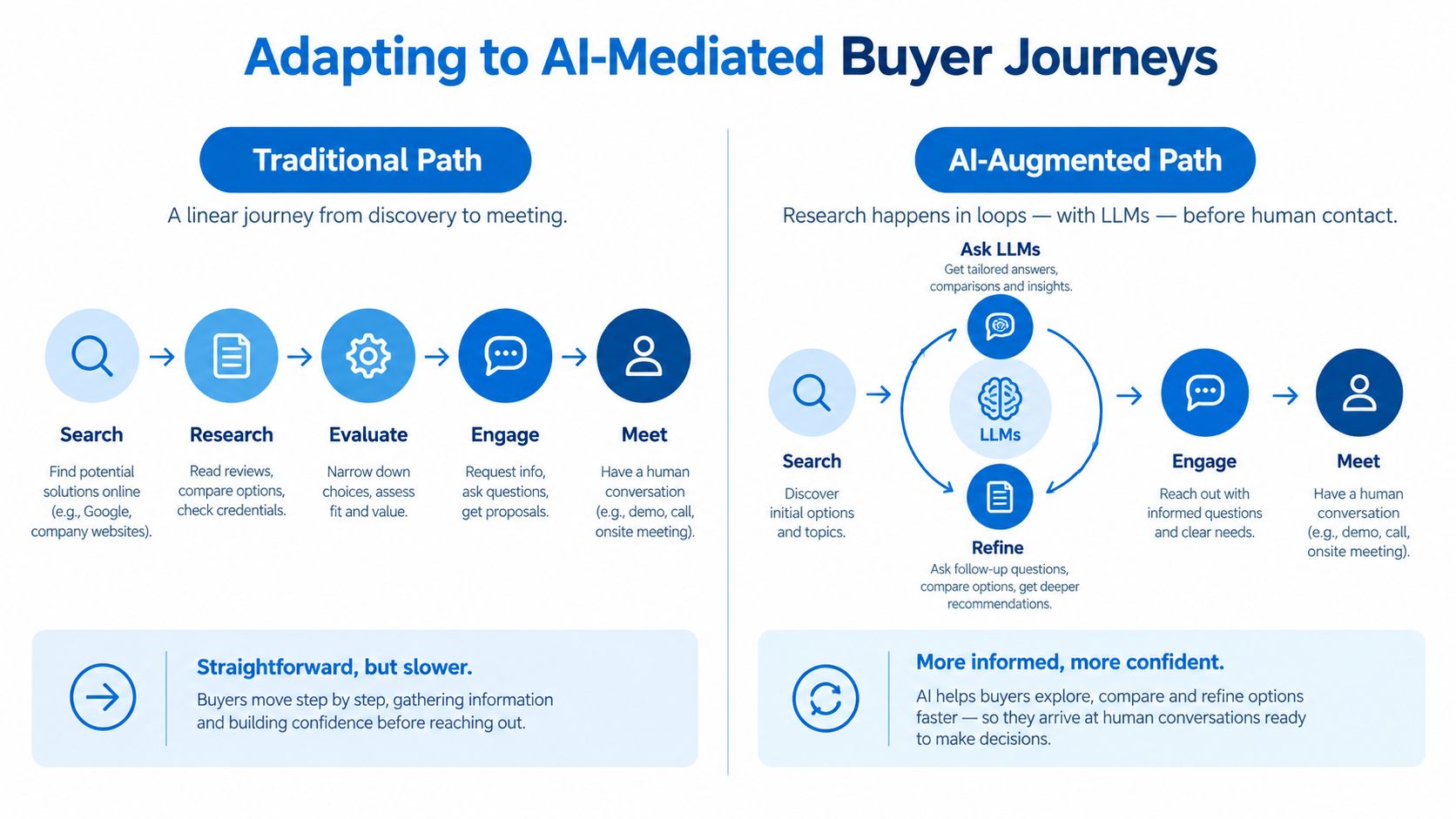
A LinkedIn message is no longer judged in isolation. The prospect may inspect the sender’s profile, scan recent posts, compare the company with alternatives, and ask an AI system to summarize the category before deciding whether to engage. That makes buyer confidence and discoverability more valuable than a meeting request sent at the earliest possible moment.
Build a research-ready presence
Your profile, content, and outreach should reinforce the same position. A buyer should be able to understand:
- Who you help: State the audience and business problem clearly.
- What you know: Publish practical analysis connected to the issues your ICP faces.
- Why you’re credible: Show relevant experience, evidence, and specific points of view.
- What happens next: Offer a useful resource or focused conversation, not an unexplained calendar link.
“Noticed your post” is weak because it describes the sender’s observation, not the buyer’s problem. A stronger message explains the operational implication of the issue raised, adds a relevant perspective, and gives the prospect enough context to continue independent research.
Measure confidence before meetings
Meeting volume still matters, but it shouldn’t be the only definition of progress. Add measures that reveal whether the account is becoming more familiar with your expertise:
- Qualified-account engagement: Are the right companies interacting with your content?
- Profile activity: Do relevant roles visit and revisit sender profiles?
- Positive replies after intent events: Do messages perform better when tied to a specific trigger?
- Research-to-conversation progression: Can anonymous interest eventually be connected to an identifiable account?
- Content-assisted opportunities: Does useful content appear in conversations that advance commercially?
These metrics won’t replace revenue reporting. They explain the steps that precede it. An AI-mediated journey rewards companies that make their expertise easy to find, understand, and verify before the buyer speaks with sales.
Integrating Signals into Your GTM Stack
A signal has no commercial value if it stays trapped in a monitoring dashboard. The revenue team needs to see the trigger, qualification status, owner, message history, reply, and next action in the systems it already uses.
Start with the data model. Define the fields that matter across LinkedIn, your CRM, and outreach platform: account, person, role, ICP fit, trigger type, signal date, buying stage, owner, status, and suppression reason. Keep the taxonomy small enough that salespeople will use it consistently.
Connect the workflow in both directions
A practical implementation sequence looks like this:
- Capture signals: Monitor posts, comments, role changes, and relevant account activity.
- Qualify against the ICP: Check company and person fit before creating an outreach task.
- Score the context: Record signal strength, recency, specificity, role relevance, and repetition.
- Create the next action: Route qualified prospects to a sequence, nurture audience, or human review queue.
- Sync outcomes back: Send replies, status changes, disqualifications, and campaign data into the CRM.
- Suppress promptly: Stop outreach when a prospect replies, converts, leaves the role, or becomes unsuitable.
Bidirectional syncing prevents the common failure where LinkedIn shows one status and the CRM shows another. It also lets marketing learn which signals precede qualified opportunities, while sales can see the context behind an automated recommendation.
A centralized inbox matters for the same reason. If replies remain scattered across individual sender accounts, managers can’t audit conversations, redistribute follow-up, or identify patterns in objections. Bring campaign-originated conversations into one operational view while preserving the sender and message context.
Choose tools for control and speed
LeadBeast is one option for teams that want LinkedIn signal monitoring, ICP qualification, signal stacking, dynamic audiences, context-aware outreach, centralized replies, CRM synchronization, and API or MCP access in one workflow. Other teams may assemble the same process with LinkedIn features, Sales Navigator, a CRM, enrichment tools, and a separate automation layer.
For teams connecting AI workflows to advertising operations, a hosted MCP server for LinkedIn Ads may be relevant, especially where programmatic control or custom reporting is required. The right architecture depends on the systems you already operate and the degree of human review your sales motion needs.
Before launch, verify the basics:
- ICP clarity: Can a salesperson explain why an account qualifies?
- Trigger logic: Does each alert include the behavior that caused it?
- Ownership: Does every qualified signal have a responsible person?
- Suppression: Will replies and exclusions stop future automation?
- CRM visibility: Can the team see campaign status and conversation history?
- Measurement: Are you tracking qualified conversations and pipeline, not only sends?
A practical review of LinkedIn lead generation tools can help compare the components before you commit to an architecture. Keep the first version narrow, test the signal definitions, and expand only after the team trusts the alerts.
The target isn’t a complicated automation project. It’s a dependable path from public evidence to qualified conversation, with enough control to protect relevance and enough feedback to improve the system.
LeadBeast monitors LinkedIn activity, qualifies people and companies against your ICP, and uses stacked signals to trigger context-aware outreach instead of generic volume campaigns. Visit LeadBeast to see how dynamic audiences, centralized replies, and CRM syncing can support a higher-quality LinkedIn pipeline.