The best AI sales tool isn’t the one with the most automation. It’s the one that solves the bottleneck your team has. A founder struggling to identify people showing buying intent needs a different system from an enterprise sales organization trying to standardize deal execution, forecast reviews, or call coaching.
This comparison evaluates seven platforms by the same practical criteria: core sales problem, AI workflow, ideal team, signal quality, implementation effort, governance, integration fit, cost visibility, and trade-offs. That matters because AI adoption is widespread, but enterprise maturity remains limited. Salesforce reported that 81% of sales teams were experimenting with or had fully implemented AI, while McKinsey found that only 21% of surveyed B2B commercial leaders had fully enabled enterprise-wide generative-AI adoption (Salesforce’s 2024 sales AI findings).
LeadBeast is the intent-first option for teams that want to turn public LinkedIn activity into relevant outreach. It isn’t the universal winner. The right choice depends on whether your primary problem is person-level intent, prospecting data, enrichment, engagement guidance, buyer prioritization, ABM intelligence, or enterprise account intelligence. Teams comparing data providers should also review this guide to the best tools for verified prospect data.
Table of Contents
- 1. LeadBeast
- 2. Apollo.io
- 3. Clay
- 4. Outreach
- 5. Salesloft
- 6. 6sense
- 7. ZoomInfo SalesOS and Copilot
- Top 7 AI Sales Tools Comparison
- Choose the Workflow Before the Platform
1. LeadBeast
Best for intent-led LinkedIn outreach
LeadBeast addresses a narrow sales problem: turning public LinkedIn activity into timely outreach. It monitors posts, comments, role changes, and competitor engagement, then combines related actions instead of treating one interaction as buying intent. A single comment may provide little context. Repeated, relevant activity from someone who fits the ideal customer profile offers a stronger basis for prioritization.
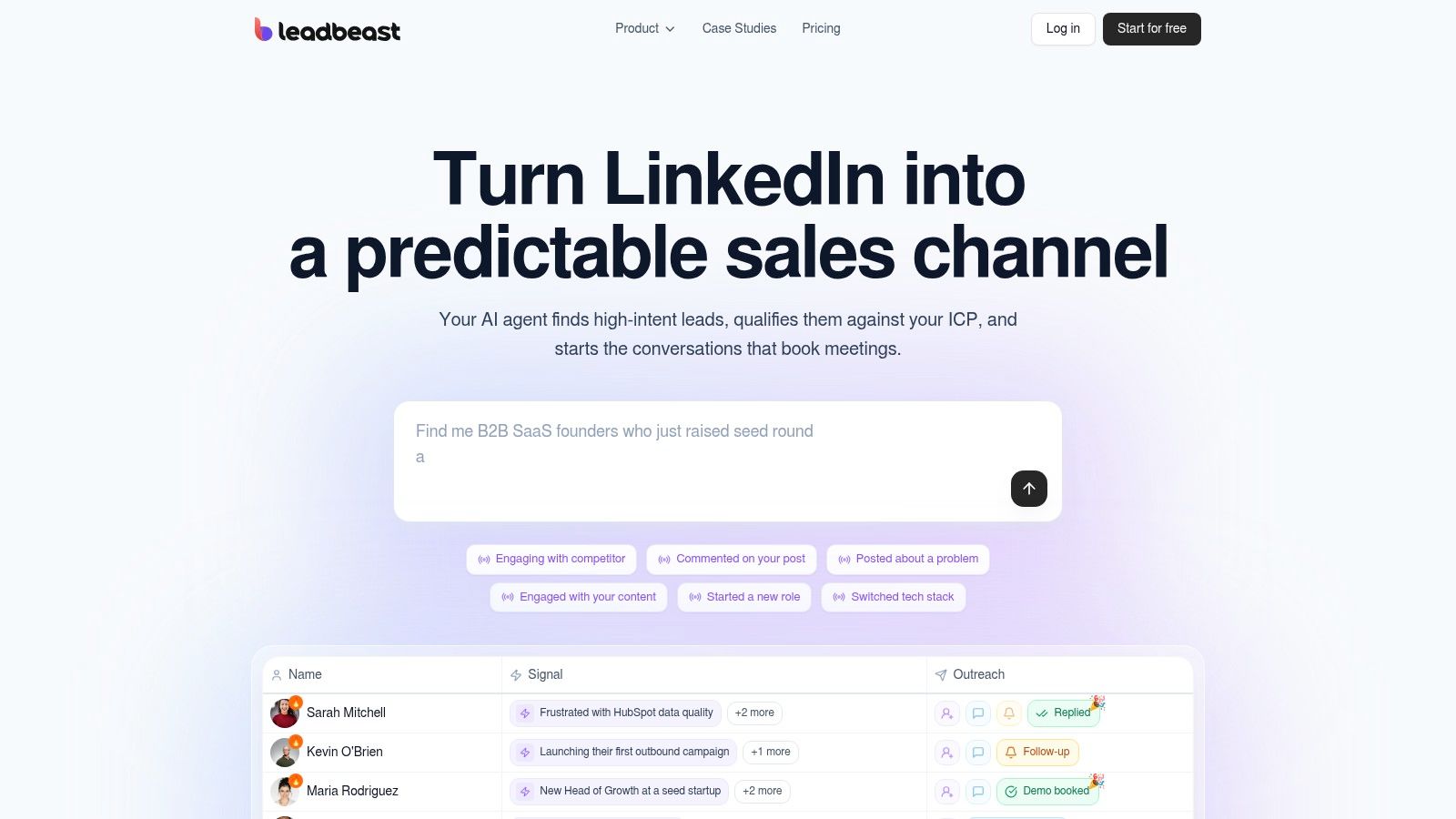
Its workflow combines plain-language ICP definitions, signal stacking, lead scoring, and living audiences. Teams describe the companies and people they want, then the audience refreshes as new activity appears. After a prospect qualifies, the AI can draft a trigger-based message, add multi-step follow-ups, and send replies to a shared inbox. Bidirectional synchronization with CRM and outreach systems supports operational handoffs, while API and MCP access allow custom workflows.
The evaluation question is simple: can a rep see why a prospect entered the workflow and judge whether contact is appropriate? Message volume alone is a poor measure of intent quality.
LeadBeast fits B2B SaaS founders, VPs of Sales, SDR and BDR leaders, agencies, and early-stage teams developing LinkedIn outbound. Pacing and sending limits are designed to resemble human activity, which addresses an implementation concern for teams building this motion. The trade-off is signal coverage. If target prospects rarely post or engage on LinkedIn, the platform has limited evidence to work with. It also cannot correct an unclear ICP or messaging that has not been tested.
The vendor publishes plans priced per LinkedIn sender, including Essential at $99 per month, Professional at $237 per month, and Business at $483 per month (LeadBeast pricing). LeadBeast also states that its plans include more than 30 intent signals, unlimited warm leads, AI outreach, lead scoring, a shared inbox, integrations, and API access. Teams should verify those capabilities in a pilot and measure sales-accepted leads and qualified conversations, rather than treating the feature list as proof of commercial value.
2. Apollo.io
Best for prospecting data and integrated engagement
Apollo.io combines a B2B contact and company database with sequencing, calling, research, and conversation workflows. Its appeal is operational compression. A team can search for prospects, enrich records, create messaging, launch sequences, and review interaction data without assembling every layer separately.
The AI Assistant and schedulable agents support account research, message drafting, follow-up recommendations, call summaries, and next actions. Apollo also supports a Chrome extension, integrated sequencing, a dialer, and conversation insights. Its AI Context Center is intended to ground outputs in company information, while support for multiple large language model providers gives teams flexibility in how they configure AI workflows.
Apollo suits startups and growth teams that need a practical starting point rather than a highly engineered data architecture. The free entry tier and public plan structure make initial evaluation easier than with sales-quoted enterprise platforms. It can also replace several point tools, which reduces integration work for small teams that don’t have dedicated RevOps support.
The main risk is cost control. Apollo uses credits for enrichment and AI-researched data, so a workflow that looks simple can consume resources through repeated searches, enrichment, or automation. Data quality also varies by segment, which means teams may need to verify important records against another source.
A useful way to place Apollo in a broader stack is to compare it with other sales prospecting tools. Apollo is strongest when the team wants database-led prospecting plus engagement execution. It is less differentiated when the primary need is real-time, person-level intent from public LinkedIn behavior.
3. Clay
Best for customizable enrichment and research pipelines
Clay is less of a finished outbound system and more of a programmable GTM data layer. Teams use it to compose enrichment and research workflows from more than 150 data providers, run AI research with Claygent, build dynamic audiences, and send qualified records into sequencers, CRMs, advertising platforms, or custom applications.
That modularity makes Clay powerful for teams with unusual qualification logic. A RevOps or GTM engineering team can combine company attributes, website evidence, hiring activity, technology information, and account-specific research into a workflow that reflects its actual ICP. Claygent can also research public web pages and documents, which helps teams move beyond fixed database fields.
The implementation burden is the price of that flexibility. Someone needs to design the pipeline, decide which providers are authoritative for each field, handle missing values, define fallback logic, and monitor credit consumption. Clay’s dual-meter model, with separate data and action or automation costs, can make forecasting harder than a flat subscription.
The more customized the enrichment workflow, the more important it becomes to document field provenance and failure states.
Clay is best for data-savvy RevOps teams, GTM engineers, agencies, and companies with bespoke account qualification requirements. It can become the backbone behind prospecting and personalization, but it isn’t automatically the easiest environment for a small sales team that wants to launch an outreach campaign immediately.
Its API, webhooks, CRM synchronization, HTTP requests, and support for customer-provided AI or API keys make it suitable for custom architectures. The trade-off is that flexibility doesn’t equal accuracy. Teams should measure how often enriched records become reviewed leads, accepted opportunities, and useful conversations, rather than assuming more data sources produce better pipeline.
4. Outreach
Best for engagement guidance and enterprise sales execution
Outreach has expanded from sales engagement into an agentic revenue platform. Its Kaia product provides live meeting guidance, summaries, action items, and coaching, while additional agents support research, personalization, deal management, and revenue workflows. The platform’s value isn’t limited to creating another message. It aims to guide the rep through what to do before, during, and after a sales interaction.
That makes Outreach a strong fit for enterprise teams with established sales processes, multiple roles, governance requirements, and a need to standardize execution quality. Real-time guidance can help managers reinforce playbooks while reps are in meetings. Conversation intelligence can also turn calls into summaries and follow-up tasks, reducing the gap between what happened in the meeting and what gets recorded in the CRM.
The platform’s breadth creates implementation work. Teams need agreement on roles, permissions, playbooks, data flows, coaching standards, and how AI recommendations should be reviewed. Smaller organizations may find that the feature set demands more change management than their current process can support.
Outreach uses a seat and consumption model, with AI credits bundled for agent usage. Pricing is custom, so buyers should ask how credit consumption changes across research, personalization, conversation, and deal workflows. Cost visibility isn’t a procurement detail here. It affects whether managers can deploy AI broadly or reserve it for specific roles and moments.
The key trade-off is between standardization and simplicity. Outreach can make a complex sales motion more consistent, but it isn’t the natural first choice for a founder who only needs to identify active LinkedIn prospects and send context-aware messages.
5. Salesloft
Best for buyer prioritization and prescriptive seller workflows
Salesloft’s Rhythm addresses a common sales problem: reps have too many possible actions and no reliable way to decide which one deserves attention first. It brings together signals such as web activity, product usage, business intelligence triggers, and CRM context, then turns them into prioritized daily work.
The platform’s Prioritizer and Account AI Agents recommend next actions, while Plays can activate when meaningful buyer behavior occurs. Focus Zones, pipeline inspection, and an integrated dialer keep sellers inside a guided workflow instead of forcing them to move between a CRM, engagement platform, analytics dashboard, and separate task list.
Salesloft fits sales teams that already have structured cadences and want AI to improve execution discipline. It is especially useful when the bottleneck isn’t finding any possible lead, but deciding which account, opportunity, or action should come next. The prescriptive model can reduce tool switching and help managers create more consistent operating rhythms.
The limitation is data configuration. Rhythm works best when the organization has mapped meaningful signals from its existing stack and defined what each signal should trigger. A noisy or incomplete CRM can produce a polished prioritization layer built on weak inputs.
Pricing isn’t publicly listed and varies by package and add-ons. Buyers should request a workflow-level estimate, not only a seat price, then ask what integrations, signal mapping, dialer use, and AI features are included.
Measure the handoff: Track whether a recommended action becomes a completed action, a qualified conversation, or a pipeline event.
Salesloft is therefore a strong choice for teams seeking a daily seller operating system, not necessarily for teams whose primary advantage comes from discovering fresh person-level intent on LinkedIn. Those evaluating the category can use this overview of sales engagement platforms to separate prioritization from message automation.
6. 6sense
Best for ABM intelligence and buying-stage prioritization
6sense is designed for account-based teams that want to identify which companies appear to be in market, estimate buying stage, and coordinate sales and marketing activity around those accounts. Its Signalverse combines intent and buyer behavior into predictive models, while Sales Intelligence features provide account summaries, alerts, recommendations, and sales assistance.
The platform is a natural fit for larger B2B organizations with ABM programs, multiple stakeholders, marketing-sales coordination, and enough account data to support predictive prioritization. It can combine company and contact data with technographics, psychographics, web deanonymization, and third-party intent. That breadth helps teams build an account-level view instead of relying on isolated activities from one channel.
6sense’s Sales Copilot and AI Writer support account research, recommended actions, and messaging. The more important workflow, however, is prioritization. A sales team can use buying-stage scores and alerts to decide which accounts deserve coordinated attention and which should remain in nurture.
Deployment can be complex for smaller teams. CRM configuration, audience definitions, account matching, marketing alignment, and sales engagement integrations all affect whether the intelligence reaches reps in a usable form. Pricing is sales-quoted, which also makes early cost comparison difficult.
The central trade-off is predictive breadth versus deterministic evidence. A model can help reveal patterns across accounts, but buyers should ask which signals are directly observed, which are inferred, how stale data is handled, and whether reps can inspect the evidence behind a recommendation. Teams comparing the category can also review these sales intelligence tools before committing to an ABM platform.
7. ZoomInfo SalesOS and Copilot
Best for enterprise account intelligence
ZoomInfo combines SalesOS data with modules for prospecting, engagement, intent, analytics, and account research. Copilot adds AI assistance for prioritization, messaging, meeting preparation, and signal aggregation across the CRM and other systems. The result is an enterprise data foundation with an AI layer designed to help sellers act on account context more quickly.
ZoomInfo is best suited to larger revenue organizations that need broad contact and company coverage, established CRM processes, and enterprise integrations. SalesOS can support contact and company research, while features such as Scoops, intent, funding information, job posts, and earnings-call signals help sellers prepare for account conversations.
The platform’s strongest differentiator is ecosystem depth. Bi-directional CRM integrations with major systems, including Salesforce and Microsoft Dynamics, can keep account information moving between systems. Copilot can then use that context to draft emails, prepare meeting briefs, surface alerts, and help sellers prioritize activity.
Cost visibility is the main concern. Pricing is opaque and typically higher than SMB-focused tools, while contract terms, modules, renewals, and data access require careful review. Buyers should ask for a complete commercial picture that includes seats, data packages, intent, exports, integrations, usage limits, and renewal assumptions.
Data coverage also shouldn’t be confused with signal accuracy. A large database can make prospecting easier, but it doesn’t guarantee that a contact is relevant now or that an account is ready for outreach. Require a sample validation exercise, inspect field provenance, and measure whether records become sales-accepted leads and qualified opportunities.
Top 7 AI Sales Tools Comparison
| Product | Implementation complexity 🔄 | Resource requirements ⚡ | Expected outcomes 📊 | Ideal use cases 💡 | Key advantages ⭐ |
|---|---|---|---|---|---|
| LeadBeast | Low, minutes to set up; plug‑in integrations | Moderate, per‑LinkedIn sender costs; active LinkedIn activity required | High-intent leads; faster demo booking (vendor-reported high connect/reply rates) | LinkedIn-first B2B outreach, agencies managing multiple clients | Intent-first sourcing, living audiences, AI moment-matched outreach |
| Apollo.io | Low–Moderate, straightforward setup; admin for credits | Moderate, data/enrichment credits and AI consumption to monitor | Faster prospecting and sequencing; variable data quality by segment | Startups and growth teams wanting unified data + engagement | Large contact database, AI agents, integrated dialer & sequencing |
| Clay | Moderate–High, build custom pipelines and automations | Moderate–High, data credits + automation/action costs; ops/engineering involvement | Highly customized enrichment and personalization backbone | RevOps, GTM engineering, teams needing bespoke data workflows | Composable data sources (150+), Claygent AI research, strong API control |
| Outreach (Kaia + agents) | High, enterprise onboarding and change management | High, seat + consumption pricing with AI credits; admin and training | Standardized execution, real‑time coaching, improved rep performance | Enterprise sales orgs focused on coaching, forecasting, deal ops | Live meeting intelligence (Kaia), agentic workflows across revenue motions |
| Salesloft (Rhythm) | Moderate, requires signal mapping and play configuration | Moderate, licensing, integrations, CRM mapping effort | Prioritized daily workflows; reduced tool switching; prescriptive next actions | Sales teams needing a single prioritized workflow and cadence | Account prioritizer, automated “Plays”, integrated dialer and coaching |
| 6sense | High, complex modeling, integration, and deployment | High, sales‑quoted enterprise pricing and implementation resources | Predictive account scoring and intent-driven prioritization | ABM-heavy enterprises that need timing and buying-stage signals | Predictive AI models, Sales Copilot, intent alerts and account scoring |
| ZoomInfo SalesOS + Copilot | Moderate–High, integration and data normalization work | High, typically costly enterprise contracts and renewals | Faster research and outreach with broad data coverage | Large organizations needing comprehensive contact data and CRM sync | Extensive dataset, Copilot research/messaging, deep CRM integrations |
Choose the Workflow Before the Platform
Start with the sales problem, not the feature list. If your team needs LinkedIn-based, person-level intent and context-aware outreach, LeadBeast is the most direct fit. It watches public activity, matches prospects against a plain-language ICP, and connects the trigger to the message and follow-up.
Choose Apollo.io when you want a relatively integrated starting point for prospecting data, research, sequencing, calling, and conversation workflows. Choose Clay when your team needs customizable enrichment and research pipelines, has the technical capacity to build them, and wants programmatic control over data sources and outputs.
For enterprise engagement, live coaching, and standardized execution, Outreach is the stronger match. For a prioritized seller workflow that turns multiple signals into daily actions, Salesloft is more relevant. Choose 6sense when predictive ABM, buying-stage intelligence, and account-level coordination are central to the revenue motion. Choose ZoomInfo when enterprise data coverage, CRM connectivity, and AI-assisted account research matter more than transparent self-serve pricing.
A platform’s AI label shouldn’t settle the decision. HubSpot’s 2025 survey found that 84% of AI-using sales professionals said AI saves time and optimizes processes, while 83% said it improves personalization and 82% said it surfaces better data insights (HubSpot’s 2025 sales strategy research). Those findings support a workflow-led evaluation, but they don’t prove that a specific vendor will improve your pipeline.
Use this selection sequence:
- Define one ICP: Specify the companies, roles, buying context, exclusions, and evidence that should qualify a prospect.
- Connect required sources: Add only the CRM, social, product, website, intent, or enrichment sources needed for the chosen motion.
- Select one narrow workflow: Start with LinkedIn outreach, account research, enrichment, meeting coaching, seller prioritization, ABM alerts, or enterprise data activation.
- Review AI and human handoffs: Inspect recommendations, message context, suppression rules, audit trails, and the point where a rep approves or rejects an action.
- Set one commercial metric: Compare qualified conversations, sales-accepted leads, opportunity creation, pipeline contribution, or rep hours per opportunity, not message volume alone.
Accuracy deserves its own test. A recent academic review cites research finding that only 35% of respondents trusted the accuracy of data used by AI in their organization, and it also highlights weak forecast reliability across sales organizations (the academic review of AI and sales data trust). Your pilot should therefore record the signal type, timestamp, qualification decision, message variant, human review, CRM outcome, negative reply, opt-out, duplicate, and account restriction. Make uncertainty visible instead of treating a score as a fact.
Run the pilot with one ICP and one sales motion. Compare intent-qualified outreach with your conventional process, review a sample of recommendations manually, and judge the result by qualified conversations or pipeline contribution. The best AI sales tools are the ones that improve decision quality and execution without weakening buyer trust. Teams looking specifically at engagement workflows can also compare options in this guide to the best sales engagement tools.
LeadBeast turns public LinkedIn activity into an intent-led sales workflow, with signal stacking, ICP qualification, context-aware outreach, reply management, and CRM synchronization. If person-level intent is the gap in your current stack, visit LeadBeast to review the workflow and start a focused pilot.