Most LinkedIn prospecting advice still treats the platform like an email list with profile pictures. The prescription is familiar: build a large cold list, send as many connection requests as possible, automate the follow-ups, and trust volume to create pipeline. That playbook confuses activity with intent.
The better operating model is narrower and more deliberate. LinkedIn for prospecting works when outreach follows a public buying signal, the message explains why that signal matters, and the seller gives the prospect a useful reason to respond. More automation can support that process, but it can’t replace judgment, timing, or relevance.
Table of Contents
- The Shift From Cold Lists to Signal-Led Prospecting
- Optimizing Your Profile for Inbound and Outbound Trust
- Finding High-Intent Prospects Using Advanced Filters
- Crafting Context-Aware Outreach Sequences
- Managing Follow-Ups and Centralizing Conversations
- Measuring Performance and Scaling Your Pipeline
The Shift From Cold Lists to Signal-Led Prospecting
The volume-first LinkedIn playbook creates activity faster than it creates pipeline. A benchmark covering 13.2 million LinkedIn connection requests found an average acceptance rate of 28.5%, while reporting that only 10.4% of outbound messages received a reply. The same LinkedIn prospecting benchmark reports that LinkedIn Lead Gen Forms convert at roughly 13%, compared with about 2.35% to 4.02% for external landing pages in industry roundups.
Volume can fill a CRM while leaving reps with weak conversations. A prospect who changes roles, comments on a relevant topic, or engages with a competitor’s subject has given the seller a reason to reach out. That reason matters more than another name added to a cold sequence.
Expandi’s H2 2026 outreach report found that campaigns built around relevant triggers reached 40% to 60% acceptance and 25% to 55% first-message reply rates, outperforming static-list outreach.
Practical rule: Ask, “What happened that makes this person worth contacting today?” before asking how many people the team can contact.
Why static lists lose context
A static list captures a prospect’s profile at the time of export. It may include a job title, company, geography, and industry. Those fields help define an audience, but they do not show whether the person is actively considering the problem you solve.
That gap leads to predictable outreach:
- The timing is unclear. The prospect may fit the ICP without having a current need.
- The opening is generic. The seller has no event to reference beyond a title or company name.
- The list decays. Roles change, priorities shift, and public activity creates information that never reaches the spreadsheet.
- The sequence becomes mechanical. Follow-ups repeat the seller’s agenda instead of responding to buyer context.
For additional context, see these prospecting on LinkedIn strategies and the practical comparison of intent signals and static lists. The operating requirement is straightforward: refresh prospect records when buyer behavior changes, not only when a salesperson uploads a new CSV.
What sustainable prospecting looks like
LinkedIn remains an important B2B prospecting channel. LinkedIn marketing materials cite research saying that 89% of B2B marketers use LinkedIn for lead generation, while 62% say it generates leads for them, more than twice the next-highest social channel.
Those figures support disciplined channel use, not indiscriminate outreach. LinkedIn gives sellers access to professional context, public activity, and senior buying roles. The advantage disappears when every interaction feels like an automated interruption.
A sustainable motion starts with a defined ICP, monitors relevant events, stacks multiple clues, and ties each message to a specific trigger. The seller still needs a credible profile and clear copy, but those elements support the signal. They do not create intent by themselves. In 2026, signal-stacking and intent-led triggers give teams a more durable alternative to high-volume automation.
Optimizing Your Profile for Inbound and Outbound Trust
Your profile is the page a prospect visits after seeing your name. It needs to answer three questions quickly: Who do you help? What problem do you solve? Why should this person trust your perspective?
A resume-style profile answers a different question, namely where you’ve worked. That information may establish credibility, but it rarely gives a buyer a reason to continue a conversation. Treat the profile as a compact landing page for the audience you want to attract.
Rewrite the visible parts first
Start with the headline. Replace a title-only description with a clear statement of audience, problem, and outcome. “VP of Sales at Acme” tells people who you are. “Helping B2B SaaS revenue teams turn buyer signals into qualified conversations” gives the right prospects a reason to look further.
The About section should sound like a useful conversation, not a corporate biography. A practical structure is:
- Name the operating problem. Describe the friction your ICP recognizes in its own language.
- Explain your point of view. State what teams commonly get wrong and what you believe works better.
- Show how you work. Describe the process without filling the section with product claims.
- Offer a low-friction next step. Invite a relevant conversation, resource exchange, or question.
Keep the first lines strong because prospects may not expand the full section. Use short paragraphs and concrete language. Avoid broad promises such as “transforming businesses” when a precise description would be more credible.
Build proof around the buyer’s question
Use the Featured section to support the same promise as the headline. Select material that helps a prospect evaluate your thinking, such as a useful framework, a relevant analysis, a customer story that you can substantiate, or a practical guide. Don’t turn the section into a warehouse of unrelated company announcements.
Your experience section should connect responsibilities to buyer-relevant work. Explain the type of teams you’ve supported, the operational problems you’ve addressed, and the decisions you help people make. If you mention outcomes, use only outcomes you can verify and explain.
The profile photo, banner, recommendations, and activity all contribute to trust, but consistency matters more than decoration. A polished banner can’t rescue a headline that says nothing, and frequent posting can’t compensate for outreach that ignores the prospect’s context.
You can use a diagnostic such as browsing the LinkedIn SSI estimator to review how your professional presence supports social selling. Treat any score as a prompt for improvement, not as a substitute for conversations with buyers.
Before launching outreach, check that:
- The headline names the audience and problem.
- The About section uses the buyer’s vocabulary.
- Featured resources support your actual positioning.
- The experience section provides credible context.
- Recent activity reinforces the same expertise your messages claim.
Finding High-Intent Prospects Using Advanced Filters
Basic filters answer, “Who could buy?” Signal stacking asks, “Who might care now?” That distinction prevents a sales team from treating every employee at a target account as equally ready for outreach.
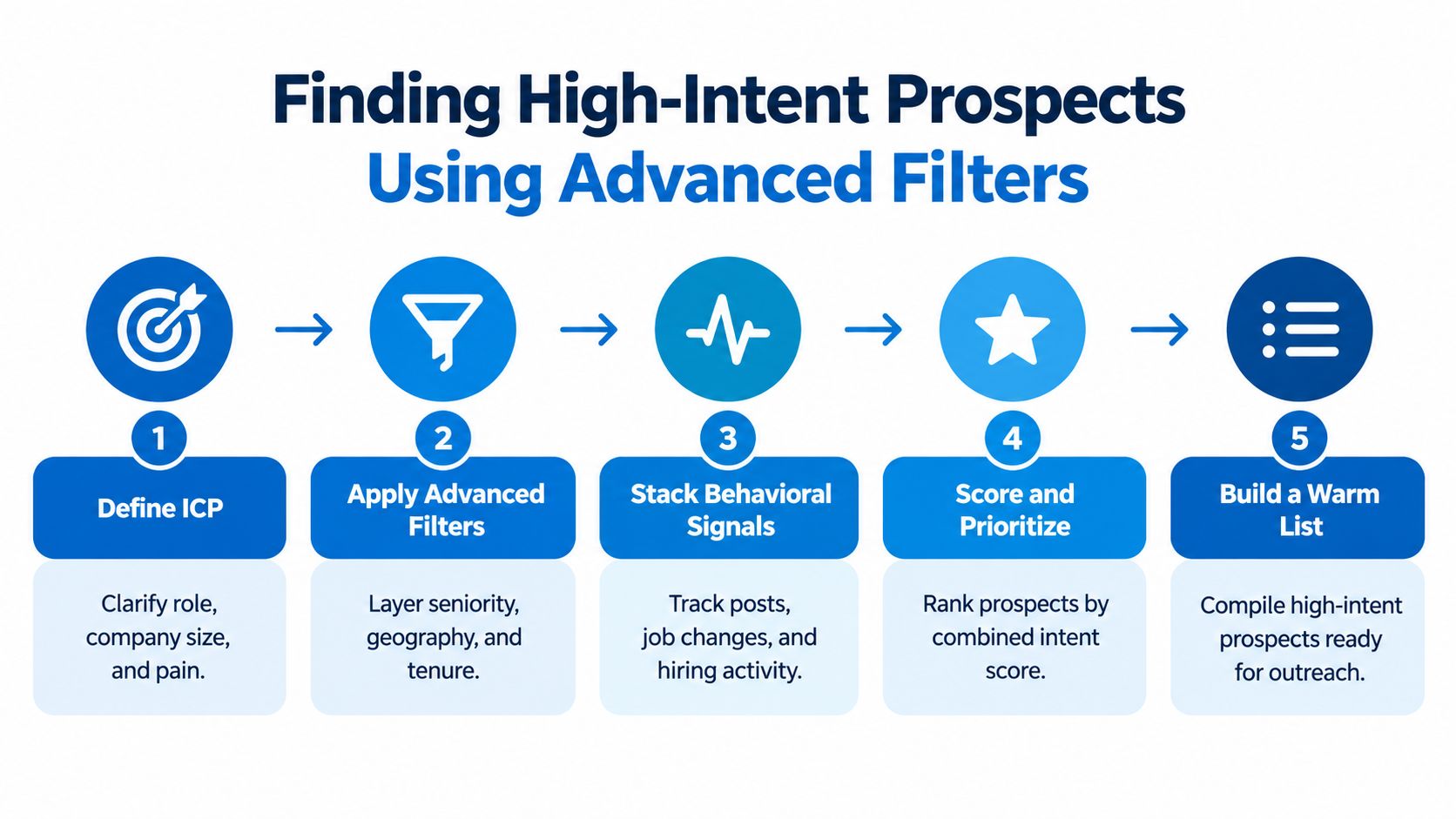
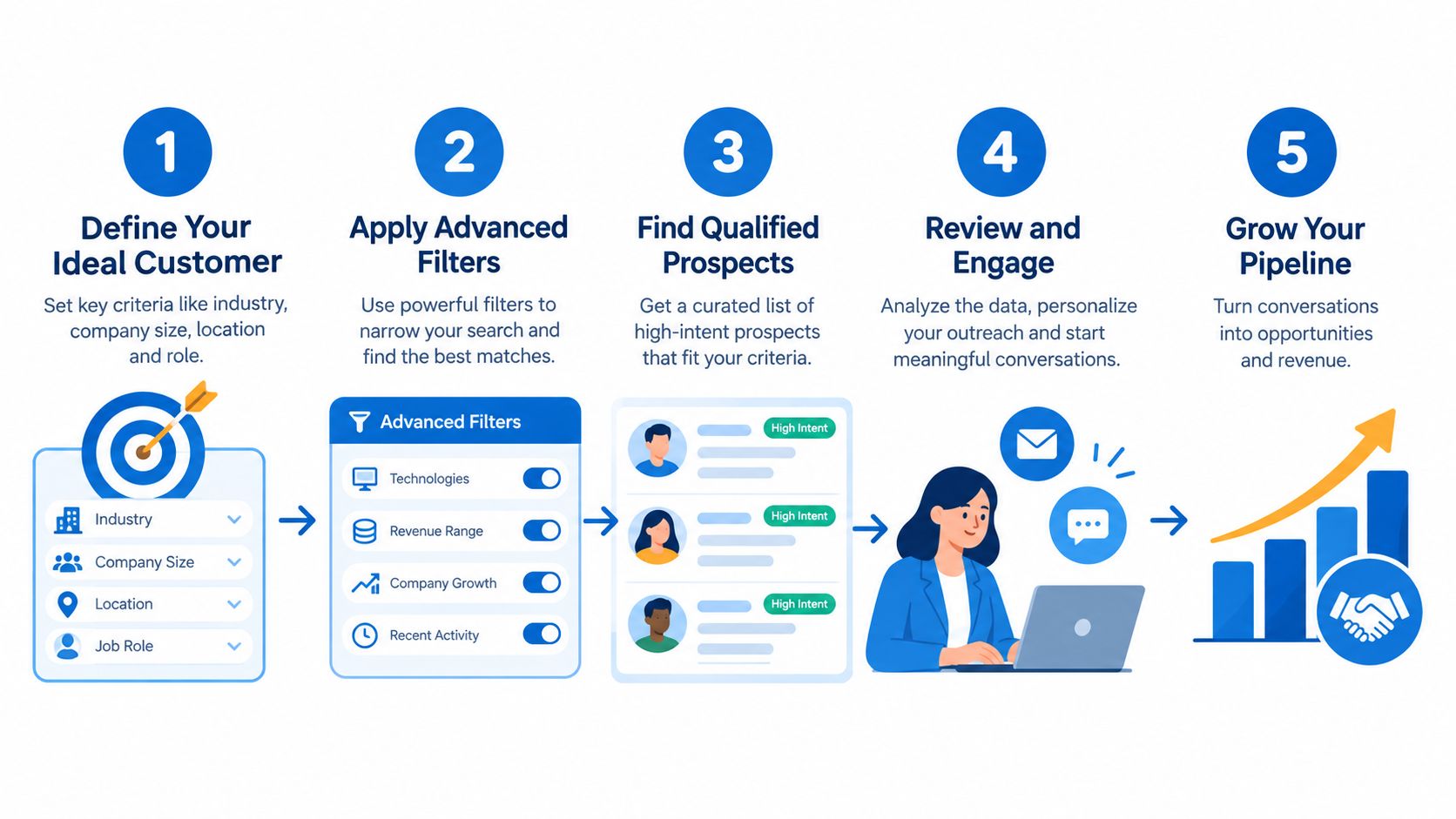
Start with the company and person criteria that define a real fit. Include role, seniority, geography, company characteristics, and the problem your product addresses. Then add behavior. A role change can indicate a new mandate. A comment on a competitor’s post can reveal active evaluation or frustration. Repeated engagement with a topic can show that the issue has moved from background noise into the person’s working agenda.
Stack signals instead of counting clicks
One isolated action is weak evidence. Someone can like a post because a colleague shared it, or change roles without having any interest in your category. Stronger prioritization comes from combining signals that point in the same direction.
For example, a prospect might:
- Fit the target role at a relevant company.
- Have recently moved into a position connected to the problem.
- Engage with content about that problem.
- Comment on a competitor’s post or follow a related discussion.
- Publish an observation that exposes a current operational challenge.
The point isn’t to assign magical certainty to every behavior. The point is to create a more defensible reason for prioritization. A seller can then write, “I noticed your recent post about…” rather than pretending a generic industry message is personal.
Turn signals into a working queue
A useful prospect queue should contain the trigger, the date it occurred, the person affected, and the next action. It should also record why the account fits the ICP. Without those fields, a signal becomes another unstructured notification that a rep sees and forgets.
Use a simple priority model:
| Priority | Evidence | Sales action |
|---|---|---|
| High | Several aligned signals and a clear business context | Research the account and send a trigger-specific message |
| Medium | Strong ICP fit with one relevant signal | Monitor activity and engage before direct outreach |
| Low | Fit without recent behavior | Keep in a nurture audience rather than forcing contact |
Dynamic audiences are more useful than exported lists because they can remove prospects when the context changes and add new people when relevant behavior appears. The seller still reviews the message and decides whether the trigger is meaningful. Automation should reduce monitoring work, not eliminate judgment.
Competitor engagement deserves careful handling. Don’t imply that a public comment proves a buying project. Use it as a conversation clue, then connect your message to a broader business issue. The respectful approach is to discuss the topic, not expose the prospect’s tracking history.
Crafting Context-Aware Outreach Sequences
A relevant trigger gives you an opening, not permission to deliver a pitch. The first message should make the connection understandable and easy to accept. The next message should add something useful. A later message can invite a conversation once the prospect has enough context to evaluate the request.

Give every touchpoint a job
A connection request can reference a post, shared topic, mutual context, or professional event. It shouldn’t carry the full sales argument. After acceptance, reconnect to the original reason and offer a brief observation that invites the prospect’s perspective.
A value follow-up needs a new contribution. Share a useful analysis, explain a pattern relevant to the trigger, or ask about a problem the prospect has already discussed publicly. “Just checking in” adds no context and makes the sequence about the seller’s need for a reply.
A later message can acknowledge a new post, company development, or role change. If no meaningful event appears, pause rather than manufacture personalization. For a fuller treatment of founder-led conversations, use this founder-led LinkedIn outreach playbook.
A practical message structure looks like this:
- Context: Name the event that prompted the outreach.
- Relevance: Explain why it connects to the prospect’s role or business.
- Value: Offer an observation, resource, or useful question.
- Permission: Let the prospect decide whether the topic is worth discussing.
Avoid copying the trigger into a template variable and calling that personalization. “I saw you changed jobs” is a fact. “People stepping into this role often inherit fragmented reporting and need to establish a reliable view quickly” is a relevant hypothesis, provided you present it as a possibility rather than an assumption.
Use AI as an editor, not a relationship substitute
AI can help generate variations from a well-defined ICP and a specific trigger. It can shorten a message, remove sales jargon, suggest questions, and flag unsupported claims. It shouldn’t invent a prospect’s pain, praise a post the seller hasn’t read, or send a message without human review.
Give the system structured inputs:
- The prospect’s role and company context.
- The public event that prompted contact.
- The problem your team can credibly discuss.
- The evidence you can share.
- The desired conversation, without forcing a meeting.
Then review every output for accuracy and tone. If the message could be sent unchanged to a hundred people, it isn’t ready.
The sequence should also adapt to responses. A positive reply requires a human answer and a clear next step. A concern deserves a direct response. Silence may justify a later value-led touch, but it doesn’t justify endless reminders.
A short visual guide can reinforce the difference between volume and relevance:
Managing Follow-Ups and Centralizing Conversations
Follow-up fails operationally before it fails creatively. Reps lose track of what they sent, why they contacted someone, and which event justified the message. The prospect then receives a duplicate question or a follow-up that ignores a reply already sitting in another tool.
A workable system preserves three kinds of context:
- Prospect context, including role, company, ICP fit, and relevant signals.
- Conversation context, including messages, objections, questions, and commitments.
- Workflow context, including the next action, owner, timing, and current stage.
A spreadsheet can support a small, carefully managed queue. As the number of active conversations grows, it becomes harder to maintain consistent timing and accurate notes. The answer isn’t to automate every message. It’s to centralize the information that lets a human make the right decision.
Separate automation from judgment
Automate administrative work such as:
- Signal monitoring: Alert the team when a relevant public event appears.
- Task creation: Create a review task when a prospect enters a qualified audience.
- Sequence timing: Suggest the next follow-up only when the previous step is complete.
- Reply routing: Assign responses to the correct owner.
- CRM updates: Record connection status, reply stage, and agreed next action.
Keep these decisions human:
- Whether the signal is meaningful.
- Whether the prospect is a genuine fit.
- What the message should say.
- Whether to stop outreach.
- How to respond to a complex question.
A centralized inbox should show campaign replies alongside the prospect’s history. That prevents a seller from treating a warm response like a cold lead and helps managers audit the quality of conversations rather than only the number of actions taken.
Make CRM syncing bidirectional
One-way exports create another version of the truth. If a prospect replies on LinkedIn, the CRM should reflect the new stage. If an opportunity is disqualified in the CRM, the outreach workflow should stop or remove that person from the active audience.
Useful fields include signal type, signal date, ICP qualification, conversation stage, last human action, next action, and reason for pause. Keep notes factual and concise. A future seller should understand the context without reconstructing the entire history from scattered tabs.
Operational standard: A follow-up is ready only when the owner can explain what changed since the previous touchpoint and why the next message helps the prospect.
Measuring Performance and Scaling Your Pipeline
Scaling LinkedIn prospecting by increasing send volume is the easiest metric to manipulate and the least reliable way to improve revenue. A safer model measures whether the team is selecting better prospects, starting better conversations, and converting those conversations into qualified opportunities.
LinkedIn’s own Sales Solutions materials report that sales professionals with strong social selling performance create 45% more sales opportunities, while businesses that prioritize social selling are 51% more likely to hit quota. The LinkedIn Social Selling Index materials also state that 65 million decision-makers and 10 million C-level executives can be reached through LinkedIn targeting. Those figures support investment in the channel, but they don’t tell a team which message to send or which account deserves attention today.
Track the complete path
Review performance in layers rather than celebrating a single acceptance metric.
- Audience quality: How many contacted people match the ICP and show a relevant signal?
- Acceptance quality: Do accepted connections progress into real conversations?
- Reply quality: Are replies questions, objections, referrals, or simple acknowledgments?
- Conversation conversion: Which replies become qualified discussions or meetings?
- Pipeline movement: Which conversations create opportunities, progress stages, or re-enter later with stronger intent?
- Safety indicators: Are people declining, reporting, blocking, or disengaging after repeated contact?
A high acceptance rate can hide poor targeting if accepted connections never discuss a business problem. A strong reply rate can also mislead if the replies come from people without buying influence. Measure the quality of the next stage, not just the action immediately after sending.
Protect the sender account
Platform constraints and audience fatigue make aggressive automation a poor foundation. Coverage of LinkedIn prospecting reports that generic connection-request response rates fell from 3.5% in May 2025 to 2.2% in April 2026, a 37% decline, while lower-volume senders were reported as more likely to achieve strong acceptance than higher-volume senders. These figures appear in PhantomBuster’s 2026 industry report.
The practical response is not to search for a larger daily limit. Use human-like pacing, vary the time between actions, review signals before sending, and stop sequences when a prospect responds or shows disinterest. Keep public engagement genuine. Don’t use likes, profile visits, or comments as empty steps in a mechanical cadence.
For a current overview of platform constraints, review LinkedIn connection request limits and their practical implications. The exact operating threshold matters less than the principle: protect the account and the reputation before optimizing throughput.
A sustainable LinkedIn motion has a smaller active audience, clearer triggers, stronger review standards, and better handoffs into the CRM. It earns scale by improving signal quality and conversation relevance, not by pushing more generic requests through the platform.
LeadBeast detects LinkedIn buying signals, qualifies people and companies against your ICP, and supports context-aware outreach, follow-ups, centralized replies, and CRM synchronization. If you’re replacing volume-first prospecting with a signal-led system, visit LeadBeast to see how it can support that workflow.