Lead scoring is a structured way to rank prospects by combining who they are, or fit, with what they’re doing right now, or intent, so sales spends time on buyers most likely to convert. About 44% of organizations systematically categorize leads with a scoring model, while benchmark reporting associates structured scoring with approximately 138% return on lead-generation investment, compared with 78% without scoring (Landbase).
But what if the highest score in your CRM doesn’t represent the best prospect, only the person who generated the most trackable activity?
That question matters because lead scoring isn’t a popularity contest. A prospect can download content repeatedly and still be a poor customer fit. Another can match your ideal customer profile perfectly but show no current buying intent. A useful system separates those signals, then adds a third judgment, readiness, before it asks an SDR to act.
Table of Contents
- The Core Idea Behind Lead Scoring
- Demographic, Behavioral, and Predictive Models Compared
- Turning the Model Into Numbers That Actually Rank
- What Scored Prospects Look Like in Practice
- When Scoring Misleads More Than It Helps
- A Practical Path to Rolling Out Lead Scoring
- Best Practices That Actually Move Pipeline
- Metrics That Prove Your Scoring Is Working
The Core Idea Behind Lead Scoring
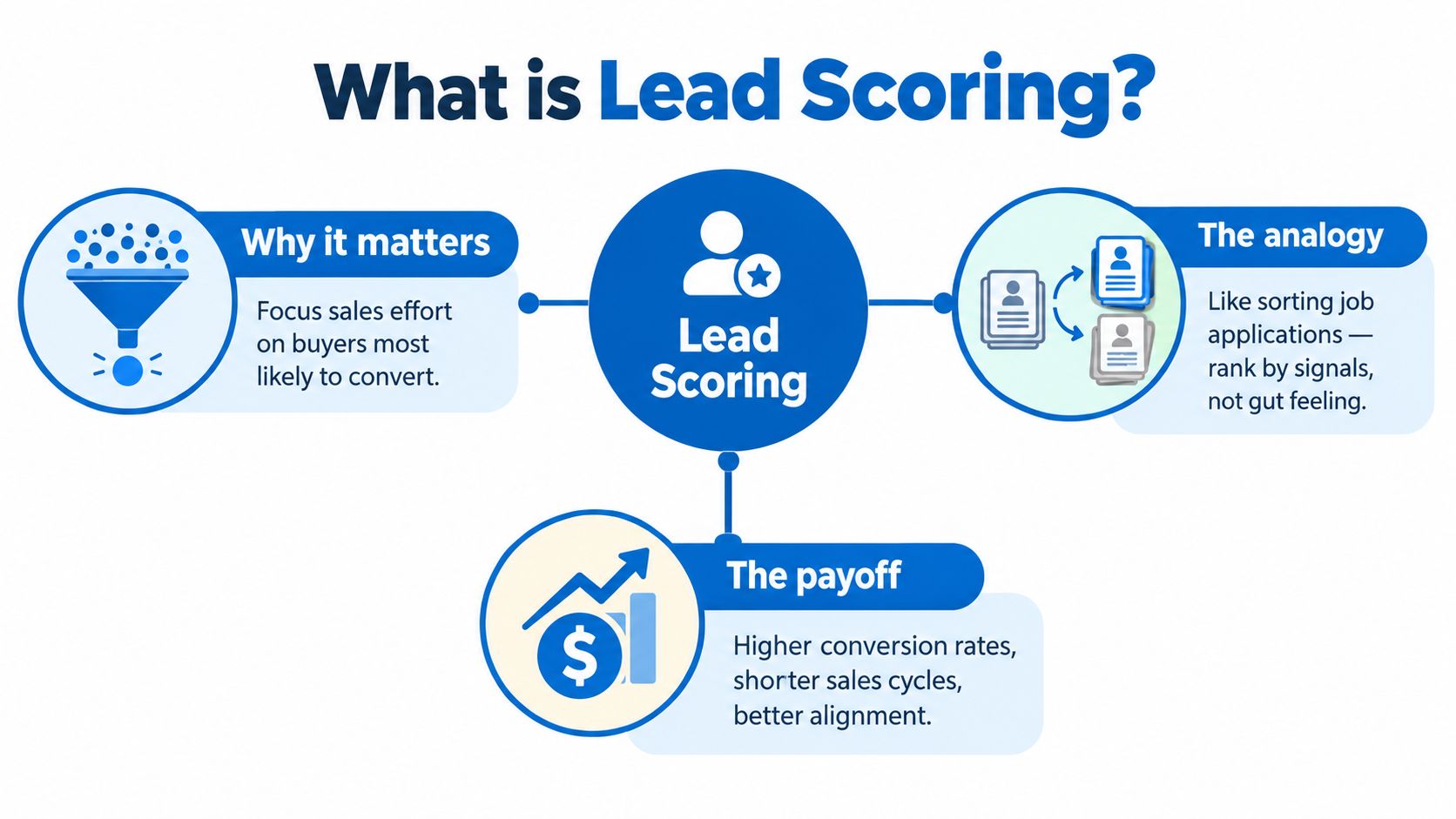
Lead scoring ranks prospects by estimating how likely they are to reach a defined business outcome, such as sales acceptance, a qualified meeting, an opportunity, or closed-won revenue. It combines fit, which describes who the prospect is, with intent, which describes what the prospect is doing.
Think of a hiring manager sorting job applications. A strong résumé establishes fit: relevant experience, appropriate skills, and a background that matches the role. An interview provides a different signal. It shows whether the candidate is engaged, prepared, and ready to move forward. A candidate with a perfect résumé but no interest in the role shouldn’t automatically outrank someone with a strong match who is actively participating in the process.
Lead scoring works the same way. A company may match your industry, size, geography, and technology environment, while a contact may hold the right seniority. Those are useful fit signals. Recent website activity, a reply, a meeting request, content consumption, or a relevant LinkedIn interaction can add intent.
The score is a decision aid
The number itself isn’t the objective. It helps a sales manager decide where limited follow-up time should go.
A score might answer questions such as:
- Who belongs in the ICP: Does the person and company resemble the customers you can serve successfully?
- Who is showing intent: Are recent actions consistent with research or buying activity?
- Who is ready for contact: Is there enough evidence to justify outreach now, or should the prospect remain in nurture?
Traditional systems assign points manually. A target title might earn positive points, while a poor-fit geography might subtract them. More advanced systems learn relationships from historical closed-won and closed-lost records. In both cases, the model should estimate a target outcome, not reward activity for its own sake.
Practical rule: A score should change a sales decision. If it doesn’t affect routing, timing, messaging, or nurture, it’s only decoration in the CRM.
Demographic, Behavioral, and Predictive Models Compared
B2B teams usually choose among three approaches. They aren’t stages that every company must follow, and the most advanced option isn’t automatically the most useful. The right starting point depends on the quality and depth of your data.
Demographic, or firmographic, scoring focuses on fit. It may reward a target industry, company size, seniority, geography, revenue profile, or technology stack. This model is quick to explain and simple to audit. Its weakness is timing. A perfect-fit account that has shown no current interest can receive a high score even when an SDR’s message arrives too early.
Behavioral scoring focuses on observable actions. A demo request, pricing-page visit, reply, event attendance, content download, or relevant LinkedIn engagement may increase the score. This approach captures timing better, but it can mistake curiosity for intent. It also lacks context if the system doesn’t know whether the person or company fits the ICP.
Predictive scoring combines both dimensions and learns feature weights from historical outcomes. Instead of asking a manager to decide every point value, it identifies combinations of characteristics and behaviors that correlate with a chosen sales result. Predictive analytics can be useful for teams deciding how to move from manually defined rules toward models trained on business outcomes. The overview of implementing predictive analytics provides broader context on that transition.
One prospect, three scores
Consider a senior buyer at a company that matches your ideal customer profile. A demographic model may rank that person highly because the fit is strong. A behavioral model may rank them low if they haven’t interacted with your marketing. A predictive model may place them somewhere between the two if historical records show that similar accounts often convert after a longer research period.
Now reverse the situation. A person may visit several pages and click multiple emails but work at a company outside your target segment. Behavioral scoring could raise their score, while demographic scoring suppresses them. Predictive scoring might learn that this combination rarely produces qualified pipeline.
The trade-off is practical:
| Model | Rewards | Common blind spot |
|---|---|---|
| Demographic | Company and person fit | Current timing |
| Behavioral | Recent engagement | ICP context |
| Predictive | Patterns across fit and behavior | Data quality and generalization |
A rule-based model is often the responsible starting point when historical labels are sparse or inconsistent. A predictive model becomes more defensible when the team has reliable outcome data, clear lifecycle definitions, and enough records to test whether the pattern holds outside the training history.
Turning the Model Into Numbers That Actually Rank
Start with the outcome, not the points. Decide whether the score predicts sales acceptance, a qualified meeting, opportunity creation, or closed-won revenue. Different outcomes produce different rankings, so a score designed for meeting booking shouldn’t be treated as a direct probability of winning a deal.
Then separate the inputs:
- Fit: industry, company size, geography, seniority, revenue, or technology environment.
- Intent: pricing activity, content consumption, replies, meetings, or relevant public engagement.
- Readiness: recency, urgency, buying stage, and whether outreach makes sense now.
A manual model can assign weights to those inputs. Recency decay prevents an old action from carrying the same influence forever. Signal stacking raises confidence when several related actions appear together, rather than treating one isolated event as decisive.
| Signal | Type | Example Weight | Decay |
|---|---|---|---|
| Target industry | Fit | High | None |
| Relevant seniority | Fit | Medium | None |
| Pricing-page activity | Intent | High | Recent activity weighted more |
| Meeting request | Intent and readiness | Very high | Short freshness window |
| Old content interaction | Intent | Low | Decays over time |
| Poor-fit geography | Fit | Negative | None |
The weights in this table are directional examples, not universal values. Your historical outcomes should determine whether a signal deserves more or less influence. Guidance on intent signals versus static lists helps clarify why current behavior often needs different treatment from a fixed prospect attribute.
A simple ranking example
Prospect A has excellent company fit but no recent activity. Prospect B has moderate fit and one recent content interaction. Prospect C has strong fit, a recent relevant interaction, and a direct request to talk. A sensible model shouldn’t rank them solely by the number of actions. It should rank C highest because fit, intent, and readiness align, keep A visible for a carefully timed account-based motion, and avoid treating B’s single action as proof of urgency.
Thresholds turn scores into action. A high band might trigger an SDR task, a middle band might enter nurture, and a low band might be excluded. Those cutoffs shouldn’t remain permanent. If the team can work only a limited number of prospects, precision at that capacity matters more than creating a large high-score queue.
What Scored Prospects Look Like in Practice
A LinkedIn-led outbound motion makes the difference between fit and intent visible.
Prospect one, the excellent fit. The contact is a senior decision-maker at a company that matches the target industry, size, and geography. The profile is complete, but there are no recent posts, comments, role changes, or other observable buying signals. The score should show strong fit, weak current intent, and limited readiness. An SDR might add the account to a monitored audience rather than send an immediate sales message.
Prospect two, the active but unsuitable contact. This person comments on several posts about a problem your product addresses and visits relevant profiles. The activity is current, but the company falls outside the ICP. A behavioral-only system might send this lead to the top of the queue. A fit-aware system keeps the intent visible while preventing an automatic handoff. The right action may be research, a partner motion, or no outreach.
Prospect three, the stacked signal. The contact works at a target company, changes into a relevant role, engages with posts about the problem, and comments on a discussion involving a related solution. No single event proves buying intent. Together, the signals create a stronger reason to investigate timing and personalize outreach around the specific trigger.
The SDR action follows the evidence
The point of scoring is not to label the third prospect a “hot lead” and stop thinking. The SDR should verify that the account still fits, inspect the context behind the interactions, and choose a message that reflects the observed situation. A role change might justify a question about priorities. A public comment might justify a relevant insight, not a generic pitch.
LinkedIn activity remains ambiguous. A person may comment because they’re networking, hiring, researching, or participating in a professional conversation. Scoring should organize attention, not replace judgment.
A score is a routing decision disguised as a number. The number earns attention, while the underlying signals determine the next action.
When Scoring Misleads More Than It Helps
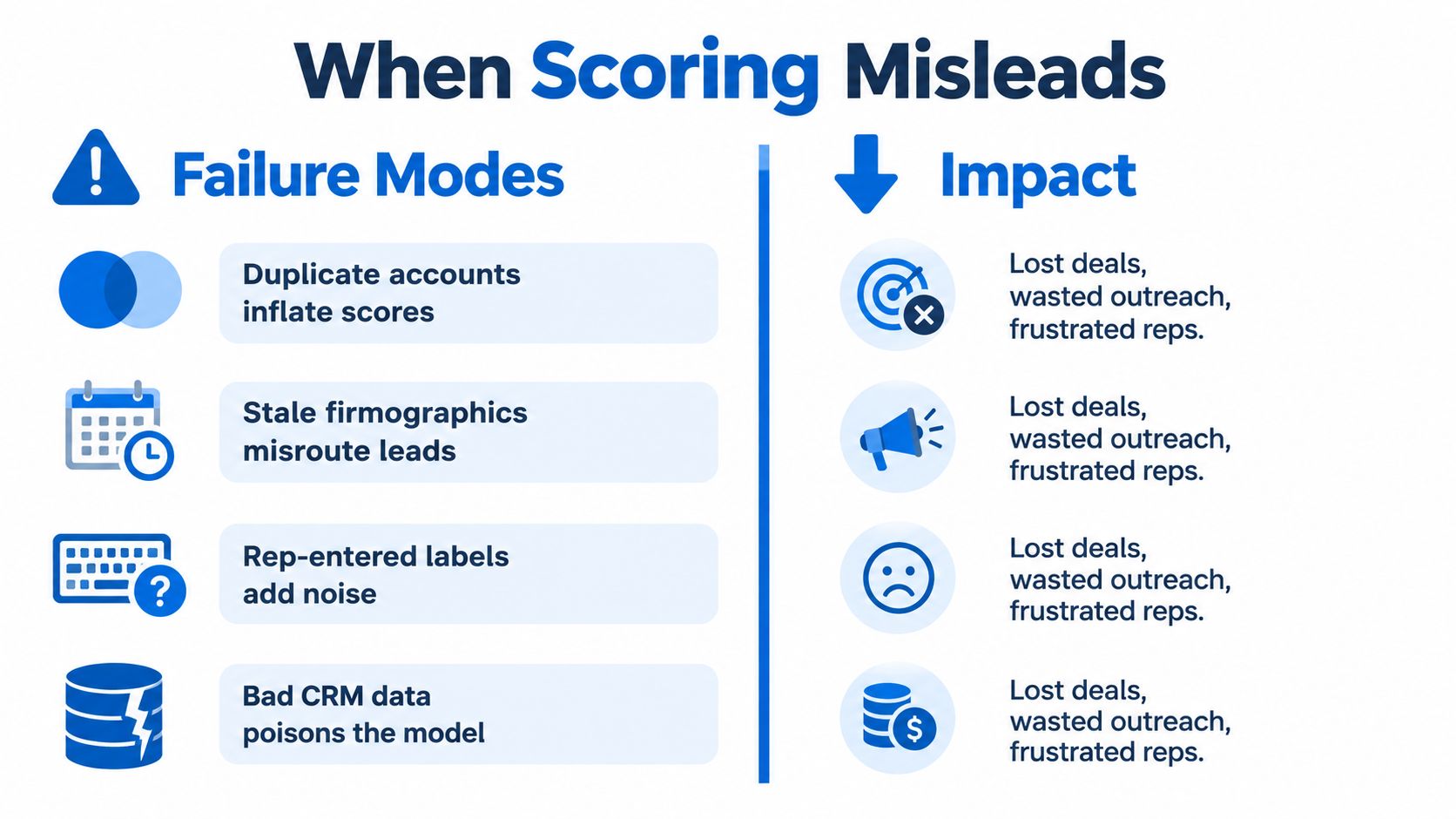
Could a high score describe a tidy record rather than a buyer? It might reflect recent activity, familiar firmographic traits, or the sales team’s past preferences instead of genuine future demand. A score becomes useful only when it distinguishes fit, intent, and readiness, rather than compressing them into one reassuring number.
CRM quality creates the first weakness. A 2025 survey of more than 600 CRM professionals found that only 24% believed more than half of their CRM data was accurate and complete. 45% said their data was not ready for AI, and 37% reported losing sales because of incorrect information (HikeFoxter). Duplicate accounts, outdated firmographics, blank fields, and conflicting lifecycle stages can make a model look exact while directing outreach toward the wrong people.
Accuracy can hide circular reasoning
Historical wins can teach a model the organization’s existing routing habits. If sales representatives previously marked particular lead sources or states as promising, the system may reproduce those labels without identifying new buying intent. A 2025 machine-learning study based on 23,154 records from one company’s Microsoft Dynamics CRM reported an AUC of 0.9891. Its strongest features included lead source, reason for state, and sales-representative classification, while behavioral engagement variables ranked lower (Baba et al.).
A high validation score still may not generalize to a new segment, channel, territory, or market. The model could be predicting how the company qualifies leads, not which prospects will buy. A separate study reported an AUC of 0.9029 for a B2B churn model using CRM data from 8,878 SME customers. That measures churn prediction, so it does not establish equivalent performance for lead conversion (Thinklytics).
Three dimensions prevent false certainty
Store fit, intent, and readiness separately. Apply freshness windows and source weighting, then show insufficient evidence when the available signals cannot support a confident recommendation.
A LinkedIn comment may provide context without indicating purchase intent. The score should expose the signal, its recency, and its confidence so an SDR can question a weak recommendation. A 0–100 total conceals those distinctions.
Testing should measure operational lift, not model elegance. The same body of research includes a reported experiment comparing 400 scored leads with 400 randomly selected leads that found no statistically significant improvement. That outcome cautions against treating a complex score as proof of causal improvement.
A Practical Path to Rolling Out Lead Scoring
Start with a plain-language ICP. Describe the company, role, problem, buying environment, and disqualifiers that matter. If marketing and sales can’t agree on those conditions, the scoring system will turn disagreement into an automated number.
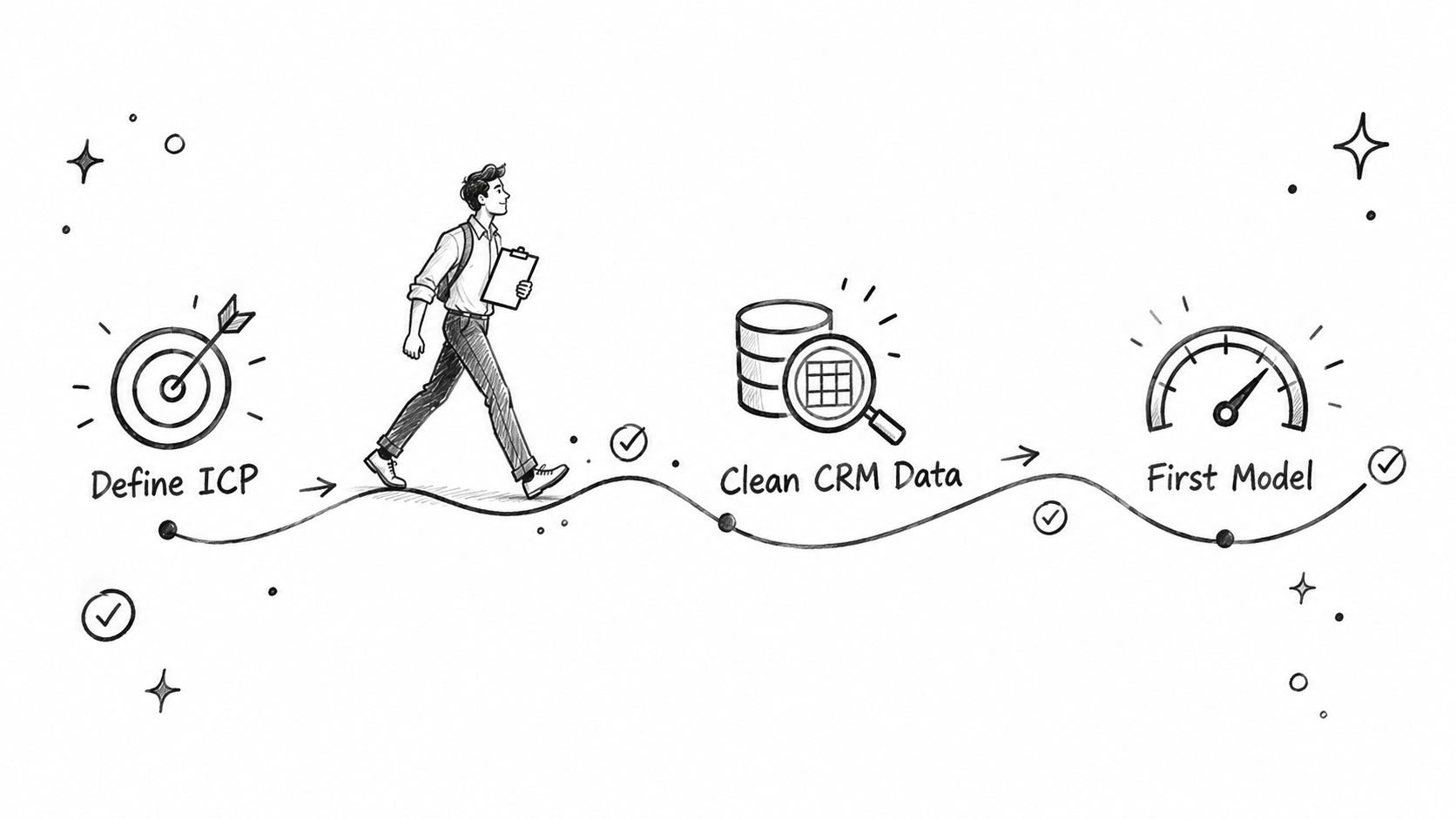
Next, audit the CRM before choosing a model. Check duplicates, stale roles, missing firmographics, contradictory lifecycle stages, and the source of every label used as an outcome. Mark fields with low confidence instead of treating blanks as negative evidence by default.
Build a small, testable first version
Choose a handful of signals with a clear reason for inclusion. Separate fit from intent, give recent actions more influence than old ones, and define what each threshold does operationally. A sales manager should be able to answer, “What happens when this lead crosses the handoff threshold?” without opening a data dictionary.
Then connect the score to the tools where work happens. CRM views, routing workflows, outreach sequences, and reporting should use the same definitions. Teams evaluating their broader operating stack can use this guide to sales intelligence tools as a reference point for comparing how data enters the process.
Validate the system against business-as-usual routing or a randomized control group. Track qualified meetings, pipeline created per sales hour, win rate, and time to qualification. A time-based holdout test is especially important for predictive models because it shows whether the score generalizes to future leads rather than merely fitting past records.
The score needs a maintenance owner. Recalibrate it when the ICP, territory structure, messaging, channels, or market changes. A model that was useful before a major positioning shift can become a source of bad prioritization afterward.
For a visual walkthrough of the process, use the following embedded resource:
Best Practices That Actually Move Pipeline
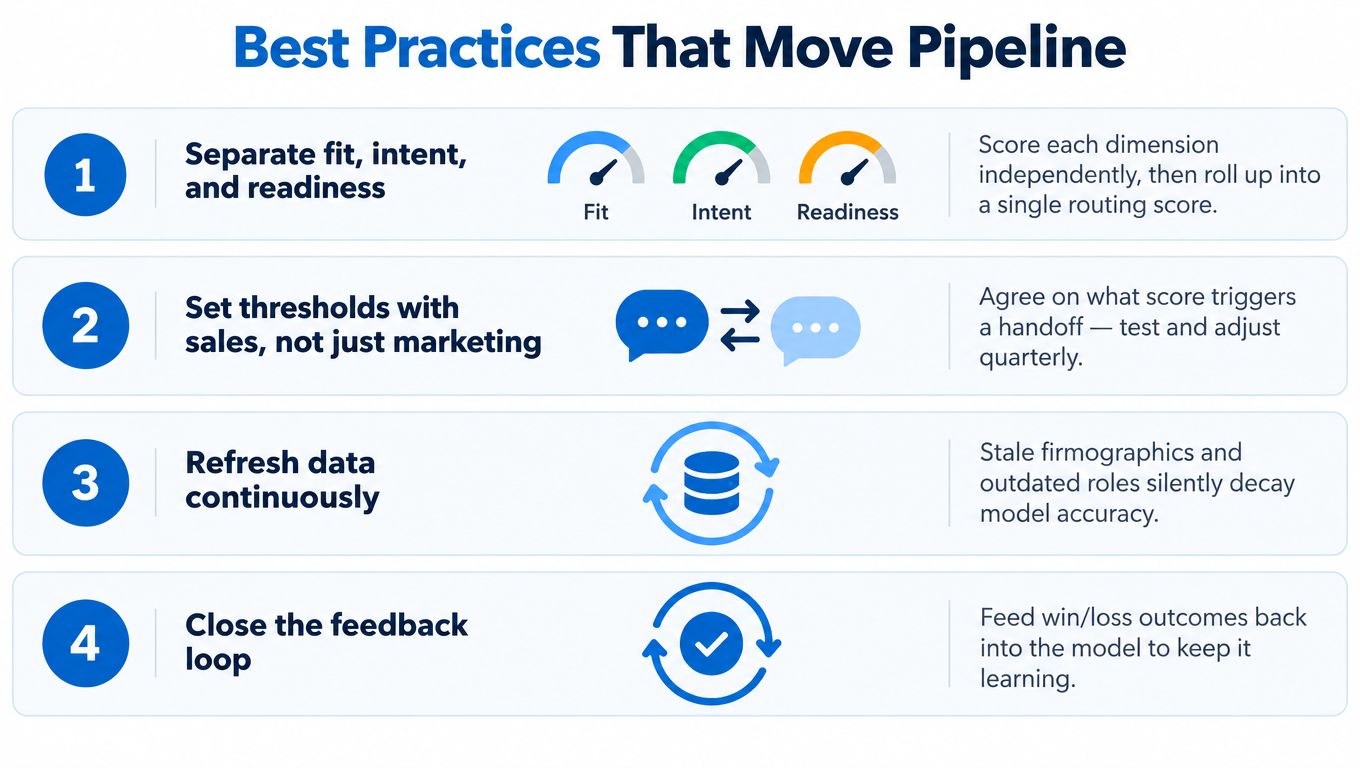
Separate fit, intent, and readiness. Keep the dimensions visible even if you also calculate a combined routing score. A high-fit account with no current activity should receive a different action from a lower-fit contact with strong intent, and neither should automatically outrank a prospect who is both aligned and ready.
Expose confidence and freshness beside the score. An SDR should see whether the company size came from a current enrichment record or an old CRM field. The same applies to behavior. A recent meeting request and an old content interaction shouldn’t look equally urgent.
Make the score explainable. Show the signals that contributed to the recommendation, including negative fit factors and missing evidence. Transparent scoring helps sales representatives trust the system without surrendering judgment to it.
Treat validation as part of the product
Recalibrate after meaningful business changes, not only when a dashboard looks wrong. New markets, territories, products, and acquisition channels can alter the relationship between a signal and a sales outcome.
Set thresholds with sales, marketing, and revenue operations together. Then compare results with a control rather than relying on a compelling anecdote from one quarter. The question isn’t whether high-scored leads look promising. It’s whether the scoring process improves decisions and outcomes compared with the process the team would otherwise use.
Metrics That Prove Your Scoring Is Working
Start with precision at actual sales capacity. If the team can follow up with only a limited portion of the addressable queue, measure how many of those selected prospects become accepted or qualified. A model that identifies a large number of interesting contacts but performs poorly within the team’s real workload isn’t useful.
Measure lift against a control, not just conversion among scored leads. Compare scored routing with randomized or business-as-usual routing, then track qualified-meeting rate, pipeline created per sales hour, win rate, and time to qualification. A high score among winners can be descriptive without proving that the score caused better results.
Watch the score, not only the outcome
Track performance by score band, segment, acquisition channel, role, geography, and company type. A headline average can conceal weak results for a new region or emerging ICP segment. Segment-level reporting shows where the model generalizes and where it needs recalibration.
Calibration deserves its own check. If leads assigned a predicted conversion probability of 0.30 convert at materially different rates, the number isn’t decision-ready. Calibration tells managers whether a score communicates meaningful probability or only provides an ordering.
For LinkedIn-led motions, keep source context visible in reporting. A guide to social media reporting for developers can help teams think about how to organize activity data, but revenue teams still need to connect engagement signals to qualification and pipeline outcomes.
Measurement principle: Accuracy alone isn’t enough, especially when wins are rare. Ask whether the score finds the right prospects at the team’s capacity, across the segments the business actually serves.
The strongest scoring system keeps the three dimensions connected without collapsing them too early. Fit tells you whether the prospect belongs in the market you serve. Intent tells you whether current behavior deserves attention. Readiness tells you whether outreach is appropriate now. When those judgments are transparent, current, and tested against a control, the score becomes an operating tool instead of a vanity metric.
LeadBeast turns LinkedIn activity into scored, ICP-qualified prospect signals by monitoring posts, comments, role changes, and related engagement before synchronizing leads with CRM and outreach workflows. Visit LeadBeast to see how an intent-led scoring and outreach process could fit your SDR motion.